Beyond Disciplines: The Academic Journey of Dr Muhammad Haque at LSST Wembley





By Kunal Chan Mehta | Article Date: 23 November 2026
Engineering, international business, finance, strategic management and artificial intelligence might appear to occupy different intellectual territories. For Dr Muhammad Haque, Senior Lecturer in Business at LSST Wembley, they are connected by a common interest: understanding how complex systems work. An engineer by training and an academic by profession, he has built a career across industry and higher education, bringing professional experience, interdisciplinary research and a commitment to continued learning into his work.
Academic expertise is often associated with specialisation. Dr Muhammad Haque, Senior Lecturer in Business at LSST Wembley, takes a broader view. His teaching interests span several disciplines; asked to define their scope, he offers a characteristically concise answer: “Almost everything.”
The light-hearted response points to a serious principle in Dr Haque’s approach to education. His career has taken him through electrical and electronics, and computer engineering, international business, accounting, finance, strategic management and higher education, with artificial intelligence increasingly featuring in his research. He sees these subjects not as separate territories – but as “interconnected fields of knowledge”, each offering a different perspective on how people and organisations operate.
His academic work includes authorship and co-authorship of books, research and a Senior Fellowship of the Higher Education Academy. Two of his recent book titles are Leadership and Change Management in the Global Landscape and Strategic Marketing Management for MSc and MBA. Dr Haque’s experience also includes leadership roles within the Bangladesh National Cadet Corps (BNCC) and the Rover Scout movement. He served as Cadet Adjutant in the BNCC’s Mainamati Regiment and received the Best Cadet award in 1997. In 2001, he served as Chief Commander in the Bangladesh Rover Scouts. These details add breadth to his professional story but the thread running through it is a willingness to explore ideas beyond the boundaries of his original training.
From engineering to the boardroom
His story begins some distance from the business classroom. Dr Haque began his professional career in 2007 at Medicon Services Ltd in Bangladesh, specialising in troubleshooting and maintaining advanced medical equipment, including diagnostic imaging systems, ultrasound machines, ECG monitors and computer-controlled medical devices. In 2009, he began his teaching career at a polytechnic institute in Bangladesh, delivering engineering education to Diploma Engineering students. He later worked in engineering in Dubai before transitioning into international purchasing management, collaborating with suppliers in Germany, Poland and Italy.
Building on his engineering background, Dr Haque expanded his expertise into business accounting, international finance, leadership and strategic management, eventually completing a Doctorate in Business Administration (DBA), specialising in mergers and acquisitions (M&As). His doctoral research investigated critical success factors in cross-border M&As involving businesses in Western Europe, mainland China and Hong Kong.
As part of his doctoral research, he developed a Multidisciplinary M&A Critical Success Factors Model, integrating six key dimensions: strategy, culture, leadership, organisation, process and externalities. The model aimed to identify critical success factors, bridge organisational competence gaps and improve international M&A success. His doctoral research also contributed to two academic books: Multidisciplinary Model to Close the Competence Gap in Mergers and Acquisition (2022) and Critical Success Factors in Mergers and Acquisitions Within Western Europe by China and Hong Kong Firms and Vice Versa (2022). His findings were also presented in the journal article “Critical Success Factors (CSFs) in Mergers and Acquisitions (M&As)”, published in the International Journal of Business and Management (2021). Together, these publications highlight his academic contributions to cross-border mergers and acquisitions, international business strategy, cross-cultural management and organisational integration.
The range of Dr Haque’s experience raises a question about what connects these fields and how moving between them has shaped his thinking. I asked how his extensive experience informs the way he approaches learning and professional challenges.
Mehta (M): Your career has taken you across several disciplines, from engineering to business and finance. What has moving between these fields taught you about the value of interdisciplinary thinking?
Haque (H): “I have always believed that learning should be a continuous process. My background in engineering gave me one perspective, while business, finance and leadership introduced me to others. Over time, I realised that some of the most interesting questions sit between disciplines. You cannot always understand a business problem through finance alone, or a technological challenge without considering the people who will use that technology. I enjoy making those connections, and I find that every new subject gives me another way of looking at the world. I don’t think learning should stop simply because you have achieved a particular qualification or reached a certain stage in your career.”
Teaching with a practical perspective
At LSST, this outlook is reflected in Dr Haque’s teaching across a range of modules within the institution’s collaborative higher education provision with university partners. Dr Haque has also undertaken Module Leader responsibilities across several academic disciplines, including Financial Reporting and Decision Making, Web Design and Coding, and Professional Life Practice. These responsibilities reflect his multidisciplinary expertise in business, finance, computing and professional development, alongside his commitment to academic leadership, curriculum development and student achievement.
For Dr Haque, effective teaching extends beyond subject knowledge. It involves simplifying complex concepts, bridging the gap between theory and real-world practice, and recognising the diverse experiences students bring to the classroom. He believes that students are not blank slates; their existing knowledge, professional experiences, ambitions and individual perspectives are valuable assets that enrich the learning process. His teaching philosophy centres on creating an inclusive, engaging and practical learning environment where students are encouraged to think critically, develop confidence and apply their knowledge beyond the classroom.
He also speaks warmly of his colleagues, describing them as “extended family”. The remark offers a glimpse of the importance he places on the relationships that sustain an academic community, alongside his interests in research, strategy and technological change.
Artificial intelligence and human responsibility
However, AI is one area in which these interests increasingly converge. AI has become a major subject of debate across business and higher education. For Dr Haque, the questions extend beyond what the technology can do. His research has considered AI and business performance, strategic decision-making, digital transformation, and the implications of generative technology for teaching, learning and academic standards.
His writing has examined AI-powered tutoring and support systems, the adoption of artificial intelligence in education, and the relationship between technological innovation and institutional responsibility. More recent research interests include human-centred leadership and employee wellbeing in AI-enabled workplaces.
These questions bring his engineering background and business expertise into conversation with his experience as an educator. They concern not only technology, but also the future of work, professional judgement and the responsibilities of organisations introducing systems that increasingly influence human decisions.
M: As AI reshapes business and education, where do you think organisations and institutions need to pay greater attention to the human consequences of that change?
H: “I think that is one of the most important questions we should be asking. AI can improve efficiency, support decision-making and create opportunities that would have been difficult to imagine only a few years ago. But technology does not remove our responsibility to think, question and make informed decisions. In business, there must still be accountability. In education, students must still develop their own judgement and understand the importance of academic integrity. I am interested in how we can embrace innovation without losing sight of the human qualities that make it meaningful. The future should not be about choosing between people and technology. It should be about understanding how the two can work together responsibly.”
Research, writing and academic practice
The range of these interests is reflected in Dr Haque’s academic writing. His research spans international business, finance, consumer behaviour, entrepreneurship, digital transformation and artificial intelligence. One recent journal publication, “Artificial Intelligence as a Strategic Enabler in Enhancing Firm Performance: A Comparative Study of SMEs and Large Firms”, examines the relationship between AI adoption and organisational performance.
His contribution to higher education also includes writing on academic practice. In his September 2026 article, Integrity with Humanity, published on LSST Blogs, he considered academic integrity, due process and institutional learning, focusing on fairness and accountability when educational institutions respond to complex academic matters.
For Dr Haque, academic integrity cannot be reduced to regulation or enforcement. It also requires sound judgement and an understanding of the people affected by institutional decisions.
His writing has also addressed the changing relationship between technology and education, including AI-powered learning and the argument that higher education should “engage constructively with technological progress rather than simply resist it”.
Alongside his publications, Dr Haque contributes to LSST’s Research Committee and undertakes academic editorial and peer-review work. His professional recognition includes Fellowship and Senior Fellowship of the Higher Education Academy, reflecting his engagement with teaching and learning in higher education.
Watching students succeed
For all his research and writing, teaching remains central to Dr Haque’s work. His experience in engineering and international business gives him a practical perspective on the relationship between theory and application, which he can bring into subjects that might otherwise remain confined to textbooks and academic discussion.
A particularly meaningful measure of this work is the progress of his students. At the 2026 De Montfort University graduation ceremony in Leicester, Dr Haque joined LSST students celebrating the completion of their degrees, including graduates he had supported during their undergraduate studies.
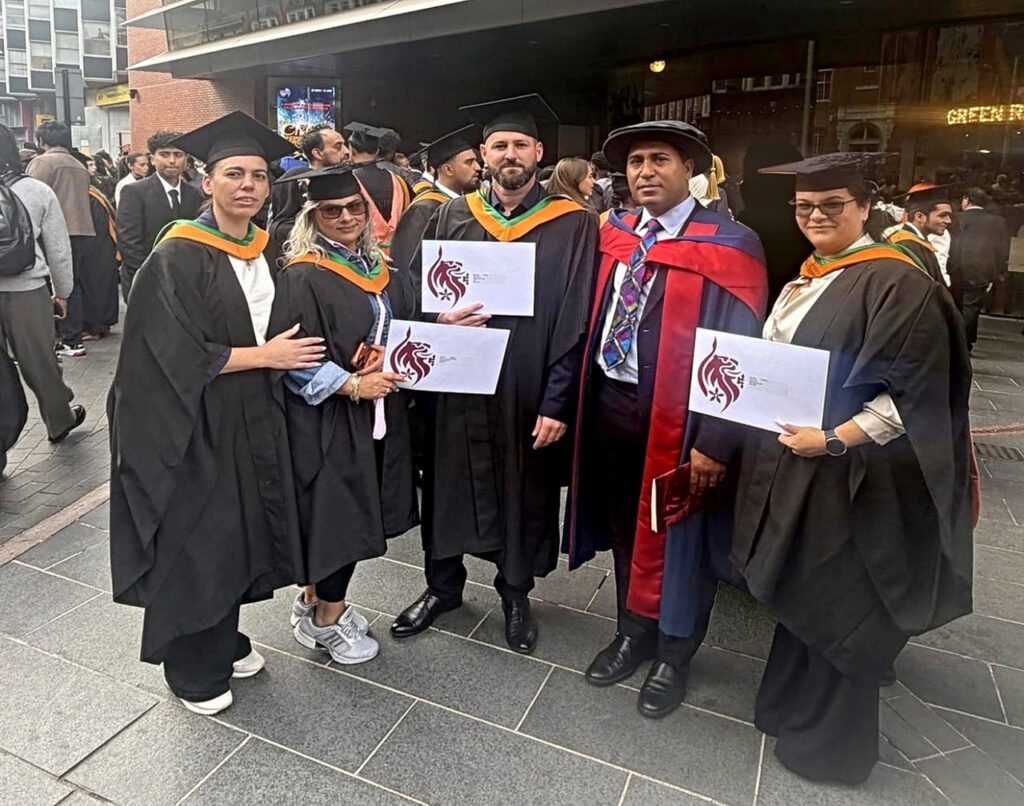
Graduation offers an opportunity to see the results of sustained work by students and the people who have supported them. For Dr Haque, the occasion also underlines that educational progress often becomes visible over time, as students develop the confidence and independence to pursue their ambitions.
M: When you look back at the students you have taught and supported, what do you find most rewarding about seeing their development?
H: “Seeing their progress. I have had the privilege of supporting students from their early undergraduate days through to graduation, and it is wonderful to see how much they develop along the way. They become more confident, more independent and more comfortable expressing their own ideas. Attending the De Montfort University graduation was a particularly proud moment. I had watched many of those students work towards that achievement, but they deserve all the credit. They put in the effort, overcame their challenges and earned their degrees. As lecturers, we can guide and support them – but ultimately it is their journey.”
Curiosity as a constant
There is a connection between this emphasis on student development and Dr Haque’s own professional journey. He has continued to explore new fields beyond his formal education. Rather than following a linear path towards a single destination, his career has evolved through successive interests and intellectual challenges.
M: After a career spanning several disciplines, what continues to make you curious about what comes next?
H: “Curiosity. I still find it exciting to discover something new, read about an emerging idea or explore a subject from a different perspective. There is always more to learn, and I think that is what keeps a person moving forward. I also take great satisfaction from seeing others develop, whether that is a student achieving something they once thought was beyond them or a colleague growing in confidence. I have never believed that education is something that ends when you leave a classroom. It is a lifelong process and I try to approach my own life in the same way.”
Dr Haque’s account returns to a consistent idea that learning is sustained by the willingness to keep asking questions. His career has brought engineering, commercial experience, teaching and research into contact, allowing each to inform the others.
That breadth is not simply a list of disciplines. Engineering has informed his understanding of business; commercial experience has given context to his teaching; and research has provided ways to examine the changing relationship between people, organisations and technology.
At LSST, these strands meet in an academic role that connects scholarship with professional practice and supports students as they develop their own ambitions. For Dr Haque, a qualification is not the end of learning – but one stage in a continuing process of discovery.
References
1. Haque, M.E. (2021) ‘Critical Success Factors (CSFs) in Mergers and Acquisitions (M&As)’, International Journal of Business and Management, 16(10), pp. 55 – 62. Available at: https://doi.org/10.5539/ijbm.v16n10p55.
2. Haque, M.E. (2022a) Critical Success Factors in Mergers and Acquisitions Within Western Europe by China and Hong Kong Firms and Vice Versa. BAYSHOP (Generis Publishing). ISBN: 9798886761399.
3. Haque, M.E. (2022b) Multidisciplinary Model to Close the Competence Gap in Mergers and Acquisition. BAYSHOP (Generis Publishing). ISBN: 9798886762815.
4. Haque, M. (2026) Strategic Marketing Management for MSc and MBA. ISP Publishers: London. Published 10 November 2026.
5. Haque, M. (2026) ‘Integrity with humanity: Academic integrity, due process, and institutional learning’, London School of Science and Technology, 1 September. Available at: https://www.lsst.ac/blogs/integrity-with-humanity/ [Accessed 6 Nov 26].
6. Haque, M.E. (2021) Critical Success Factors (CSFs) in mergers and acquisitions (M&As) within Western Europe by Mainland China and Hong Kong firms and mergers and acquisitions in Mainland China and Hong Kong by Western European firms: A comparative study. Doctoral thesis. University of the West of Scotland. Available at: https://ethos.bl.uk/concern/thesis_or_dissertations/841732 [Accessed: 10 November 2026].
7. Yildiz, F., Haque, M.E. and Desta, A. (2026) ‘Artificial intelligence as a strategic enabler in enhancing firm performance: A comparative study of SMEs and large firms’, Journal of Management and Training for Industries, 13(2), pp. 101 – 115. https://doi.org/10.12792/JMTI.13.2.101.
For further details or media enquiries, contact LSST’s Public Relations Manager via kunal.mehta@lsst.ac.
Enjoyed reading LSST News? Discover your path and explore opportunities across our academic community at www.lsst.ac/courses or via admissions@lsst.ac. Think Further. Think Higher. Think LSST.