From AI Users to AI Thinkers: Preparing Students for the Future of Work





A student sits down to write an assignment. Within seconds, AI can generate an introduction, suggest references, and structure an argument. The temptation is obvious: why struggle with the first draft when a tool can create one instantly? But the harder question students need to ask themselves is: If AI does the thinking before I do, what exactly am I learning?
That question is becoming increasingly relevant across higher education. Many students are already using tools such as ChatGPT, Gemini, Copilot, or similar AI platforms. However, confidence in using these tools effectively, ethically, and critically does not always match usage.
Two Ways of Getting It Wrong (and How They Affect Your Career)
There are broadly two ways students respond to AI, and both can create significant hurdles for graduate employability:
- The Avoidance Trap: Some students steer clear of AI entirely, either out of suspicion or a sense that using it somehow doesn’t count as “real” work. However, AI is already becoming part of everyday professional environments. From communication tools and design platforms to research databases and data analysis software, graduates will increasingly encounter AI-supported systems in the workplace.
Avoiding AI altogether does not protect independent thinking. Instead, it can mean entering employment without confidence in using technologies that employers increasingly expect professionals to understand.
- The Over-Reliance Trap: The opposite extreme is allowing AI to complete the thinking process. A student who asks AI to create an assignment outline, generate a presentation, or produce an analysis without critically engaging with the output may save time, but risks losing the very process that develops valuable skills: analysing information, forming arguments, solving problems, and making decisions.
Employers are not looking for graduates who simply know how to ask AI to complete tasks. They need professionals who can work alongside AI — people who can provide direction, evaluate information, ask meaningful questions, and apply their own judgement.
Deep learning happens through active engagement: questioning, structuring ideas, revising, making mistakes, and understanding why something works (Biggs and Tang, 2011). Handing this entire process to AI can limit the development of independent reasoning and critical thinking skills (Zhai, Wibowo and Li, 2024).
What sits between avoidance and dependence is direction: learning to steer AI rather than defer to it.
Levelling the Playing Field: Digital Equity at LSST
AI literacy is not simply an individual responsibility. Students start their degrees with different levels of digital confidence, access to technology, and previous experiences with digital tools.
If AI skills are treated as something students should already know, technology risks becoming another dividing line where digitally confident users progress faster while others are left behind.
By embedding AI literacy into academic and career support, it becomes a levelling skill — ensuring all students have the opportunity to develop the digital confidence, critical thinking, and adaptability needed for future employment.
Generative AI has significant potential to support learning, personalise assistance, and improve productivity, but only when used thoughtfully (Kasneci et al., 2023). Without critical engagement, AI can produce responses that are generic, outdated, incomplete, or inaccurate.
At LSST, the aim is not simply to teach students how to use AI tools, but to help them understand when, why, and how to use them effectively.
AI Doesn’t Understand – It Predicts
To use AI professionally, you have to understand what it actually does. AI does not “understand” concepts through experience or human reasoning. It understands concepts through experience, reasoning, or human judgement. Instead, it generates responses by identifying patterns from large amounts of existing data.
This means AI can be a powerful support tool, but it is not automatically reliable. It may produce incorrect information, fabricated references, or responses that appear convincing without being accurate.
The quality of AI output depends heavily on the quality of human input.
This is why future professionals need more than technical ability. They need the ability to question, evaluate, and improve what AI produces.
Building AI Confidence at LSST: Working With AI, Not Against It
At LSST, developing digital confidence is part of supporting student success. Through classroom discussions, academic support, skills development sessions, and conversations around responsible technology use, students are encouraged to build confidence in engaging with emerging tools ethically and effectively.
From the start, students are introduced to the idea that AI should support learning rather than replace it. Students are encouraged to explore practical uses of AI, including brainstorming ideas, breaking down complex concepts, exploring alternative perspectives, creating study plans, and developing learning roadmaps.
However, students are also guided to understand the limitations of these tools. AI does not have personal experiences, independent ideas, or professional judgement. While it can provide suggestions and support learning, it cannot replace the human skills that shape meaningful education, such as interpretation, creativity, reflection, and decision-making.
If students rely on AI to generate responses without adding their own thinking, they risk producing generic work and missing opportunities to develop their own perspectives. Independent learning requires active engagement, questioning ideas, evaluating information, and making informed decisions.
At LSST, the aim is to help students become confident AI users who know when to use AI, when to question its responses, and when their own judgement must take priority.
Mastering the R-T-C-F-A Prompting Framework
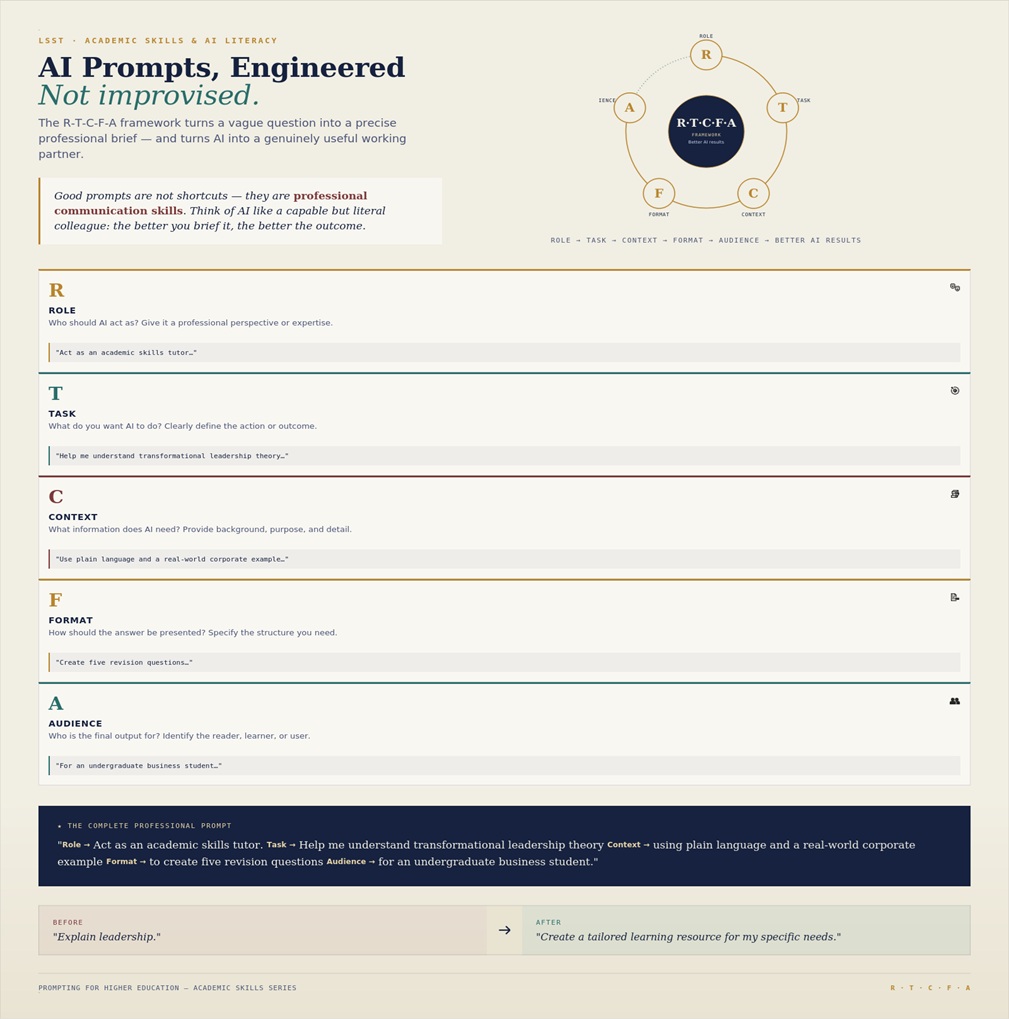
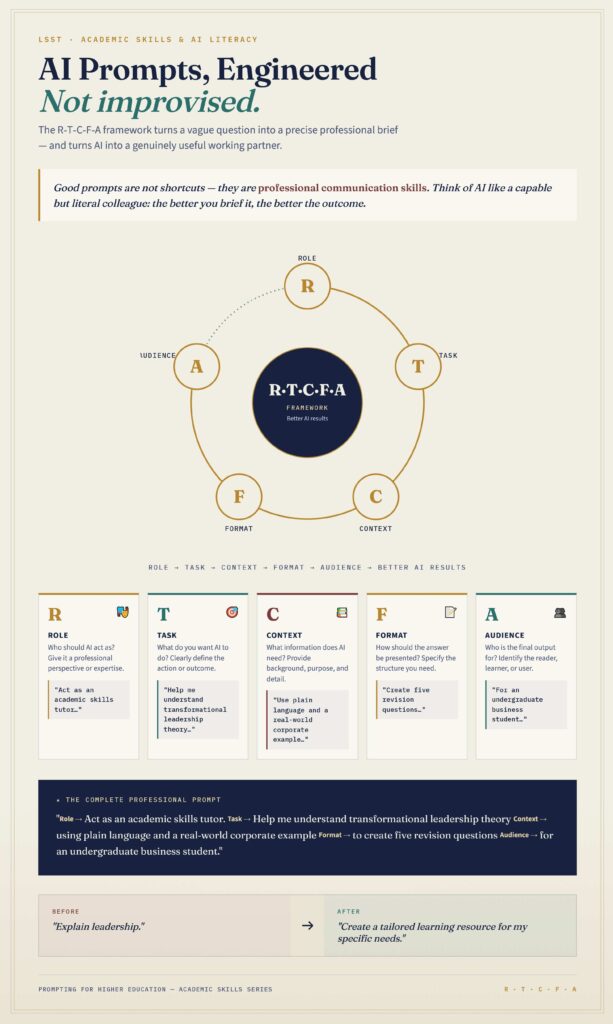
Prompting is a genuine professional skill, not a shortcut. Think of it less like typing a Google search and more like briefing a capable but literal colleague. To get the best results, structure your instructions using the R-T-C-F-A framework:
- Role: Give the AI a persona.
- Task: Clearly define what needs to be done.
- Context: Provide the background details.
- Format: Specify how the output should look (bullet points, email, essay).
- Audience: Define who the final output is for.
The Professional Prompt in Action: “Act as an academic skills tutor [Role]. Help me understand transformational leadership theory [Task] using plain language and a real-world corporate example [Context] to create five revision questions [Format] for an undergraduate business student [Audience].”
Precise instructions transform a generic response into a tailored and more effective study aid.
Knowing When to Doubt the Answer
In the workplace, employers don’t just value people who can generate ideas; they value people who can spot mistakes.
Generative AI tools are also known to “hallucinate”, producing convincing responses that may contain fabricated facts or non-existent academic references. For LSST students preparing for professional careers, this creates an important responsibility: becoming evaluators of information, not simply consumers of it.
Treating an AI response as a first draft- one that must be checked, questioned, and improved is one of the most valuable habits graduates can develop for their future careers.
Speed Isn’t the Same as Progress
One of the biggest misconceptions is that AI is only valuable if it makes tasks faster. But efficiency and deep learning are often at odds. A student who spends thirty minutes questioning, restructuring, and correcting an AI-generated response will come away understanding far more than a student who spends five minutes copying a finished answer. Learning requires friction. Take the friction out entirely, and you take away the opportunity to grow.
Why This Matters Beyond the Degree?
Ultimately, your course is not just about completing assignments. It is about developing the skills students will carry into the workforce.
Technology will continue to evolve faster than any university can teach every specific tool graduates may encounter throughout their careers. What higher education institutions can develop is something more valuable: adaptability.
Employers need professionals who can learn new systems, communicate effectively with technology, and make sound, ethical decisions using the information and tools available to them.
The future worker is not someone competing with AI. It is someone who knows how to combine their own uniquely human judgement, critical thinking, creativity, empathy, and adaptability with what technology can offer.
The question for LSST students is not whether AI will be part of their future. It already is.
The real question is whether they will use it passively or purposefully.
The graduates who succeed will not be those who let AI think for them. They will be those who have learned how to think alongside it.
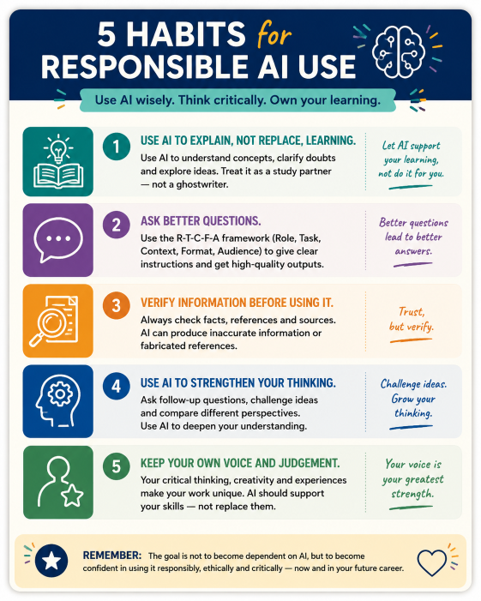
5 Habits for Responsible AI Use
1. Use AI to explain, not replace, learning: Use it as a personal tutor, not a ghostwriter.
2. Ask specific questions with clear context: Use the R-T-C-F-A framework to get high-quality outputs.
3. Check facts and references before using information: Never assume an AI’s output is 100% accurate.
4. Use AI to improve your thinking, not avoid thinking: Use the back-and-forth dialogue to challenge your own assumptions.
5. Keep your own voice and judgment: Always keep your unique perspective at the absolute centre of your work.
References
- Biggs, J. and Tang, C. (2011) Teaching for Quality Learning at University. 4th edn. Maidenhead: Open University Press.
- Kasneci, E. et al. (2023) ‘ChatGPT for good? On opportunities and challenges of large language models for education’, Learning and Individual Differences, 103, 102274.
- Zhai, X., Wibowo, S. and Li, L. (2024) ‘The effects of over-reliance on artificial intelligence dialogue systems on critical thinking and learning’, Educational Technology Research and Development.