INTEGRITY WITH HUMANITY






|
Academic integrity, due process, and institutional learning A higher education governance reflection arising from the case of Professor Jason Arday. |
By Dr Muhammad Emdadul Haque (SFHEA, NCEE), Senior Lecturer at LSST Wembley
CONTENT NOTEThis article addresses bereavement, mental health, and a recent death. Please consult a trusted contact or Medical Practitioner if affected by these themes or experiencing mental health difficulties. Samaritans, Mind, and NHS mental health services are also sources of support. In situations of danger or urgent medical need, contact emergency services or attend your local Accident & Emergency department. |
CASE CONTEXT AND EVIDENTIAL BOUNDARIES
Distinguishing bereavement, academic processes, and institutional review
Professor Jason Arday died aged 41 on 14 August 2026. While his death is a matter of profound sadness for those who knew him, it is treated separately here from the academic and institutional processes that preceded it. Those processes involved distinct questions relating to his publications, qualifications, honorary appointments, and tenure at the University of Cambridge. This article examines the implications of those processes for governance and accountability in higher education, while carefully distinguishing between allegations, reviews, investigations, findings, and outcomes (Hui, 2026; University of Cambridge, 2026a, 2026b, 2026c).
TABLE 1 | FACT BOUNDARIES
|
Question |
What reliable sources establish |
What cannot responsibly be concluded |
|---|---|---|
|
Thesis and publication allegations |
Cambridge University announced on 2 August that plagiarism allegations related to the thesis and some journal publications had been investigated by LJMU and the journals involved. Guardian News reported that the Liverpool John Moores University (LJMU) had not upheld plagiarism charges and attributed identified issues to honest and reasonable errors. |
That every subsequent allegation or concern was solved by the previous process conducted by LJMU or that all journals arrived at the same finding. |
|
Qualifications and honorary appointments |
On 5 August, Cambridge University announced a new investigation into the latest information regarding academic qualifications and honorary appointments; it separately noted ongoing complaints about academic misconduct. |
That the investigation process has already confirmed that any disputed qualification, appointment, or claim was false. |
|
Appointment and time at Cambridge |
On 12 August, the Vice-Chancellor announced a separate investigation into the circumstances regarding the 2022 appointment and Arday’s tenure at Cambridge. The investigation results are intended to inform a review of senior appointment process. |
That Cambridge University had been found guilty of having made a mistake in due diligence or recruitment governance. The announced process should not be anticipated. |
|
Death |
Arday died in London on 14 August 2026, aged 41. Police describe the death as unexpected and not believed to be suspicious. |
A causal link between the controversy and his death cannot responsibly be asserted unless established by competent authorities and evidence. |
Sources: Adams and Bakare (2026); University of Cambridge (2026a, 2026b, 2026c); Hui (2026).
THE LESSON
01 Achievements, allegations, and due process
Jason Arday’s public record includes scholarship, activism, institutional recognition, and later controversy. In 2023, Cambridge University profiled Arday as an academic and advocate of race, inequality, and education working towards increasing access for disadvantaged groups. For analytical purposes, these aspects should be considered alongside, but not conflated with, the subsequent allegations and institutional questions (University of Cambridge Faculty of Education, 2023).
Scholarly work can contribute to the creation of new knowledge, robust policies, enhance the student experiences, and public confidence; thus, concerns about unacknowledged use of academic work such as ‘borrowing‘ or misrepresentation should be subject to rigorous analysis. At the same time, when concerns are raised, due process depends upon maintaining clear distinctions between allegations, suspicions, and findings, while recognising the evidential limits of any review or investigation. This is necessary to preserve confidence in both academic standards and institutional decision-making.
A proper institutional response must avoid oversimplification of any case into a dichotomy of either condemnation or defence. It should consider the evidence, distinguish honest errors from misconduct, provide an opportunity to respond meaningfully, correct the record where appropriate, and make conclusions proportional to the evidence identified.
|
ANALYTICAL STARTING POINT A robust response should be exacting about both the quality of scholarship and the fairness, care and accuracy of the process used to assess it. |
02 Integrity as a system of accountability and support
According to the 2025 principles of the UK Concordat, summarised in the UK Research Integrity Office (UKRIO) guide, the principles of integrity include honesty, rigour, transparency and open communication, care and respect, and accountability (UKRIO, 2025a). This wider notion is important as the evidence to be considered during any plagiarism disputes often requires careful consideration. The use of detection tools, screenshots and parallel-text comparisons can identify material requiring scrutiny, but such evidence alone is insufficient to determine intent, context, responsibility, or outcome. Likewise, concerns about the communication of allegations should be examined separately from the underlying scholarly issues. Each question demands evidence that is relevant and proportionate to the matter under consideration.
An institutional integrity system should bring together accountability, due process, and appropriate support. Its purpose is to establish the facts, reach evidence-based conclusions, determine proportionate actions, and correct the research record where necessary. At the same time, institutions have a responsibility to ensure that those involved are treated fairly and have access to appropriate wellbeing support. Care and support do not replace evidential findings, but neither should the existence of an investigation diminish an institution’s duty of care.
03 Due process in high-profile cases
The scrutiny of high-profile cases can develop more quickly than a formal investigation. Precision therefore begins by identifying which process dealt with which concern. The University of Cambridge stated on 2 August that allegations concerning Arday’s thesis and certain publications had been investigated by LJMU and the relevant journals. The Guardian newspaper then reported that LJMU did not find evidence of plagiarism, attributing the identified issues to ‘honest and reasonable academic error.’ This finding is important but should not be extrapolated to later and different concerns (University of Cambridge, 2026a; Adams and Bakare, 2026).
The 2025 UKRIO Template procedure suggests clear, proportionate, fair and robust processes, emphasising transparent handling, timely identification of a problem, protection of staff and research participants, evidence-based corrective action, and consistently applied regularly reviewed procedures (UKRIO, 2025b). For practical implementation, universities should appoint an impartial case manager, retain relevant documentation, define allegations clearly, ensure access to appropriate expertise, disclose relevant information fairly, provide opportunities for response, document the rationale for findings, and establish realistic timelines.
Independence and proportional safeguards are particularly important in high-profile cases. UKRIO guidance emphasises fair and impartial processes and the management of real or perceived conflicts of interest, while recognising that not all investigations require external review (UKRIO, 2023, 2025b). The level of oversight should reflect the circumstances of the case. Where confidence in an internal process may be limited, measures such as independent chairs, external expertise, declarations of interest, or oversight outside the decision-making chain may strengthen confidence in outcomes while preserving institutional responsibility.
|
LANGUAGE THAT PROTECTS DUE PROCESS Institutions should distinguish carefully between an allegation, a concern, a review, a finding, and an outcome. A statement that a university is investigating a concern should not be presented as though misconduct has already been established. Equally, the fact that an earlier review found no plagiarism does not automatically prevent a later concern from being examined where new evidence or information emerges. |
04 Support alongside investigation
Appropriate support for the person concerned does not mean compromising investigative rigour. According to UKRIO’s Advice for Respondents (March 2023), the personal stress connected to allegations of misconduct or poor practice must be considered and the importance of clarity of procedures, rights, wellbeing, and support must be emphasised (UKRIO, 2023). The same applies to complainants, witnesses, students, co-authors, and other parties affected by the investigation process.
A proper model of investigations separates the evidential process from the support process. The former seeks to establish the facts and determine proportionate outcomes, while the latter addresses wellbeing, workload, communication, representation, safety, and protection from retaliation. Maintaining this distinction is important for procedural fairness: counselling does not imply exoneration, procedural support does not constitute advocacy, and safeguarding arrangements do not resolve evidential questions. Named welfare contacts, access to occupational health or counselling services, mechanisms for reporting personal and professional threats, proportionate management of workload, and regular updates on case progress can help mitigate the risks associated with uncertainty and prolonged stress. Subsequently, the University of Cambridge stated that mental health and security support continued after Arday’s resignation, despite ongoing public debate regarding the adequacy of that support (Hall, 2026). Public debate alone cannot determine the adequacy of support in an individual case. The wider governance lesson is the need to document support provision, assess its accessibility, and review risks as circumstances change.
A PRACTICAL INSTITUTIONAL MODEL
Balancing accountability and wellbeing
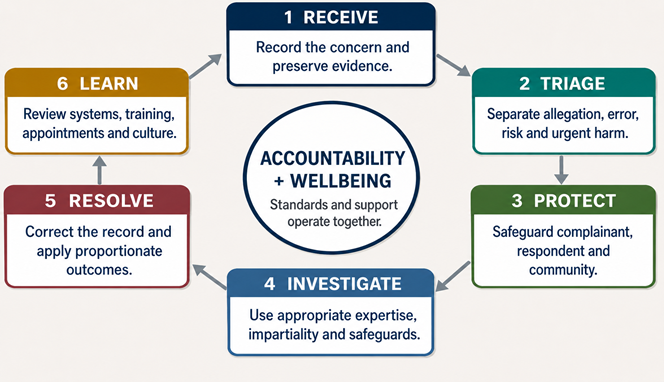
The following framework reflects an institutional response to research integrity concerns. It is a conceptual framework, inspired by the 2025 UK Concordat principles, UKRIO’s guidance, and Universities UK’s Stepchange framework for mentally healthy universities.
The Integrity-with-Humanity Framework
A proportionate institutional response to concerns about academic work
|
HOW TO READ THE FRAMEWORK “Protect” precedes “investigate” because immediate safety, evidence retention, and protection from retaliation cannot wait for a conclusion. “Learn” follows “resolve” because significant cases can inform improvements to systems, including where misconduct is not established. |
|
• |
Receive concerns through a confidential, accessible route and preserve original material. |
|
• |
Triage the concern: differentiate between attribution problems, honest errors, poor practice, disputed interpretation, misconduct, and safeguarding risk. |
|
• |
Protect everybody involved but do not promise the outcome. |
|
• |
Investigate with relevant expertise, appropriate impartiality, disclosure, rights of response, documented reasons, and reasonable timeline. |
|
• |
Resolve proportionately: correct the record, provide learning experience, and apply disciplinary actions when justified by evidence and policies. |
|
• |
Learn institutionally by reviewing recruitment, supervision, training, workload, communication, and research culture. |
05 Recruitment governance should be examined, not presumed
Arday’s case raises critical issues regarding recruitment governance; however, this alone is insufficient for concluding that the University of Cambridge did not conduct due diligence. On 12 August, the Vice Chancellor said an inquiry would be undertaken into the situation of Arday’s appointment in 2022 and his tenure. This inquiry will contribute to the review of the appointment process of senior scholars (University of Cambridge, 2026c).
However, the more general governance issue is a future-oriented one and not simply a finding of this case. In the field of higher education, when it comes to appointments, there needs to be proportional verification of qualifications, employment records, publications, achievements, and references, the extent of which depends on the seniority and responsibilities of the position. In cases of doubt about such an appointment, there needs to be use of the correct process for review and corrections of public information if necessary.
This approach is entirely compatible with inclusive recruitment. Verification standards should be applied consistently to all candidates, regardless of background, and should not be increased retrospectively in response to later scrutiny. Effective due diligence is evidence-based, proportionate and fair, while recognising that credibility assessments can be influenced by social networks, institutional cultures, and unconscious bias.
|
INCLUSION AND VERIFICATION Inclusion and verification can both work together at once. Inclusive recruitment broadens the pool of talent, while consistent verification helps ensure that all candidates are assessed against the same standards. |
06 Teach integrity as a developmental practice
Cambridge University’s 2023 profile of Jason Arday described his reflections on developing academic writing skills without consistent early mentorship and on learning through repeated rejection and feedback (University of Cambridge Faculty of Education, 2023). Whatever conclusions may be reached about disputed texts, those reflections highlight a broader lesson for higher education: universities cannot assume that the skills underpinning academic integrity are acquired automatically. Referencing, paraphrasing, source management, and scholarly writing are learned practices that require guidance and continued development throughout an academic career.
For that reason, integrity education should be viewed not only as a compliance requirement or a response to misconduct concerns, but as an ongoing element of academic development. Doctoral candidates, supervisors, early-career researchers, and senior academics can all benefit from regular training in quotation, paraphrasing, co-authorship, note-taking, version control, citation software, data management, corrections, and the responsible use of generative AI. Such training is often most effective when it is grounded in discipline-specific examples rather than generic definitions of plagiarism.
Supervision and mentoring also play a vital role. Researchers may understand the principle of avoiding plagiarism yet still struggle to distinguish effective synthesis from overly close paraphrasing, particularly when working under linguistic, cognitive, or time pressures. Formative feedback, writing support, and good record-keeping practices provide opportunities to strengthen these skills before problems become embedded in the scholarly record. Viewed in this way, integrity is not simply a matter of rule compliance; it is a professional competency that develops through education, practice, reflection, and support.
07 Communicate facts with precision and respect
Institutional public statements should clarify which process has started, which body is responsible, procedural limitation of the available information, and when the next update can be expected. Character assessments, selective disclosure, and language that predetermines the status of a respondent, complainant, or outcome are inappropriate and should be avoided.
Media literacy is also important. One needs to understand whether the claim in question is an allegation, correction, formal finding, or commentary; whether the respondent received a fair opportunity to respond; whether the passages in the academic work are shown in context; and whether the source makes a difference between textual similarity and misconduct. This will allow for more accurate scrutiny by maintaining visibility of the evidence and proper process.
Public discussion of Arday’s case has intersected with wider debates about equality, diversity and inclusion, race, and institutional credibility. However, an individual case cannot be used to validate or invalidate broader policy agendas. Issues of discrimination, academic standards, governance, and inclusion should be assessed on their own evidential merits. Maintaining these distinctions helps avoid assumptions and supports more balanced analysis.
FROM LESSON TO ACTION
A six-part compact for higher education
TABLE 2 | INSTITUTIONAL ACTION PLAN
|
Principle |
Concrete institutional action |
Evidence of success |
|---|---|---|
|
1. Verify |
Conduct proportionate due diligence regarding qualifications, publications, employment, and material public claims prior to appointment or promotion. |
Documentation of checks; discrepancies addressed before public announcement. |
|
2. Investigate |
Conduct according to the published procedure, using relevant expertise, providing appropriate impartiality and conflict safeguards, disclosure, right of response, and reasons. |
Timely, reviewable decisions differentiating allegations, findings, and corrections. |
|
3. Support |
Facilitate separate welfare contacts and safety procedures for complainants, respondents, witnesses, and affected teams. |
Awareness of where to seek help; management of identified risks and workload pressures. |
|
4. Communicate |
Provide accurate information about the status and correct any misinformation about the institution if necessary. |
Messaging is accurate, proportionate, and in line with the procedural status. |
|
5. Repair |
Correct relevant publications, repositories, and web pages; make outcomes proportional to severity, intent, pattern, and impact. |
Research record is factual, and outcome is clearly proportional. |
|
6. Learn |
Use significant cases to review recruitment, supervision, training, governance, and culture. |
Actions, owners, and deadlines are reported to relevant governance bodies. |
Author synthesis based on UKRIO research-integrity guidance and the principles discussed in this article.
CONCLUSION
Accountability, due process, and institutional learning
The central governance lesson is that research integrity is strongest when academic standards, fair procedure, proportionate support, and organisational learning operate together.
The circumstances surrounding the Jason Arday case raise important questions for higher education, but they do not provide simple answers. Allegations, investigations, findings, questions of governance, and issues of wellbeing each require careful and distinct consideration. The challenge for institutions is not to choose between accountability and compassion, but to demonstrate both. Research integrity is strengthened when standards are rigorous, processes are fair, communication is measured, and support is available to those affected. The most resilient institutions are those that can pursue the truth, uphold due process, and learn from difficult cases without losing sight of the people involved.
References and source notes
|
Adams, R. and Bakare, L. (2026) “Cambridge professor Jason Arday resigns amid accusations of plagiarism”, The Guardian, 5 August. Available at: https://www.theguardian.com/education/2026/aug/05/cambridge-professor-jason-arday-resigns-amid-accusations-of-plagiarism (Accessed: 22 August 2026). |
|
Hall, R. (2026) “Cambridge University defends its mental health support for Jason Arday”, The Guardian, 16 August. Available at: https://www.theguardian.com/uk-news/2026/aug/16/cambridge-university-jason-arday-mental-health-support (Accessed: 22 August 2026). |
|
Hui, S. (2026) “Black professor at Cambridge who faced plagiarism claims is found dead”, Associated Press, 15 August. Available at: https://apnews.com/article/jason-arday-cambridge-professor-london-dead-reports-9036e2b405f5849415534e80bb1b9cb1 (Accessed: 22 August 2026). |
|
UK Research Integrity Office (2023) “Advice for respondents”, written by Nicola Sainsbury, March. Available at: https://ukrio.org/our-work/get-advice-from-ukrio/answers-to-common-enquiries/advice-for-respondents/ (Accessed: 22 August 2026). |
|
UK Research Integrity Office (2025a) “What is Research Integrity?” Available at: https://ukrio.org/about-us/what-is-research-integrity/ (Accessed: 17 August 2026). |
|
UK Research Integrity Office (2025b) “Procedure for the Investigation of Misconduct in Research”. Available at: https://ukrio.org/our-work/procedure-for-the-investigation-of-misconduct-in-research/ (Accessed: 17 August 2026). |
|
Universities UK (2020) “Stepchange: Mentally healthy universities”. Available at: https://www.universitiesuk.ac.uk/what-we-do/policy-and-research/publications/stepchange-mentally-healthy-universities (Accessed: 17 August 2026). |
|
University of Cambridge (2026a) “Statement on research integrity allegations”, 2 August. Available at: https://www.cam.ac.uk/news/statement-on-research-integrity-allegations (Accessed: 22 August 2026). |
|
University of Cambridge (2026b) “Statement regarding further inquiries into academic qualifications”, 5 August. Available at: https://www.cam.ac.uk/news/statement-regarding-further-inquiries-into-academic-qualifications (Accessed: 22 August 2026). |
|
University of Cambridge (2026c) “Vice-Chancellor announces review of senior appointment processes”, 12 August. Available at: https://www.cam.ac.uk/news/vice-chancellor-announces-review-of-senior-appointment-processes (Accessed: 22 August 2026). |
|
University of Cambridge Faculty of Education (2023) “Spotlight: Professor Jason Arday”, 10 March. Available at: https://www.educ.cam.ac.uk/news/spotlight-jason-arday/ (Accessed: 22 August 2026). |