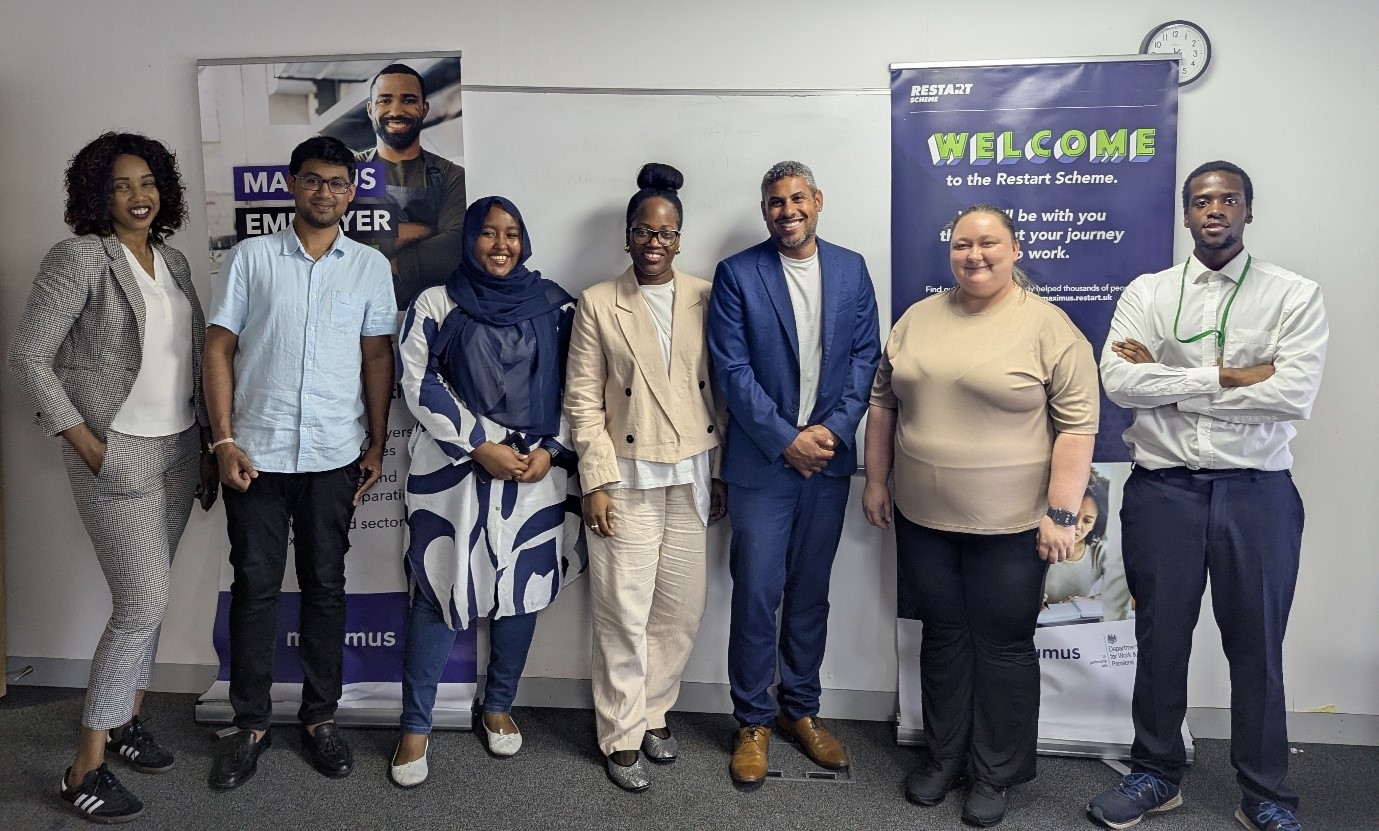
New Painting and Decorating courses will help hundreds of London adults develop practical skills and take their first steps towards employment or self-employment.
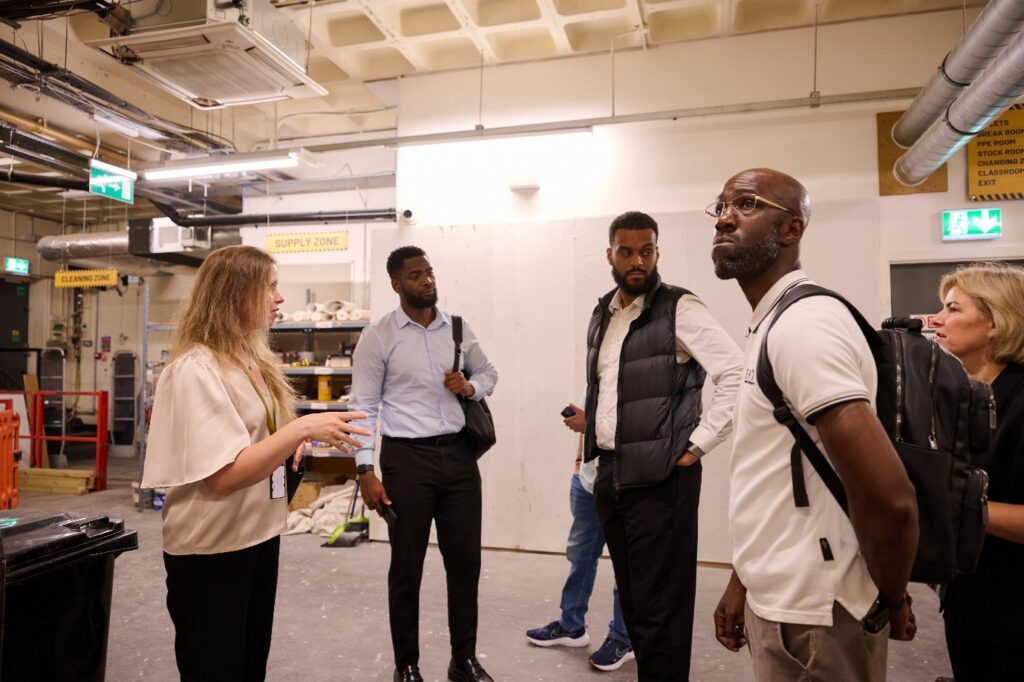
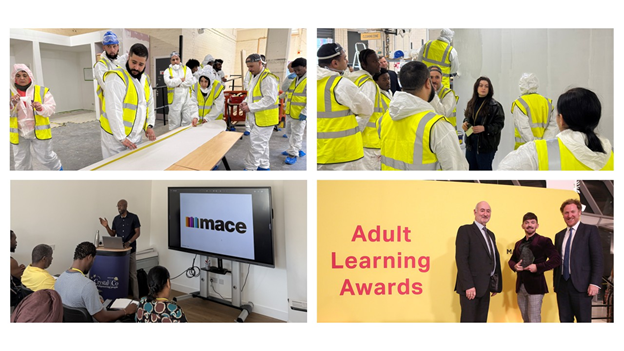
LSST learners work together to prepare and repair walls as part of their practical construction training at Wembley. Photo: LSST..
LSST is expanding its construction training at Wembley after securing £500,000 in new funding from the Greater London Authority (GLA).
The funding will enable LSST to extend its successful construction programmes to eligible adults across London, with new six-week Painting and Decorating courses designed to give learners practical skills, recognised qualifications and a clearer route into the construction industry.
Learning the trade is only half the story. Learners will also learn what it takes to make a living from it – writing estimates and customer quotes, raising invoices, developing a marketing plan and building a pipeline of work. It is a practical introduction to self-employment that is designed to help turn new skills into a sustainable career.
They will also visit live building sites and meet employers and job agencies, allowing them to see construction careers at close range and understand what employers expect from people entering the industry.
‘Following our successful Skills Bootcamp, I am delighted to welcome new learners to our Wembley campus as part of the London Talent Pathway funded by the GLA,’ said Faye Meleti, Senior Programme Manager at LSST. ‘There is a huge demand for construction skills in the city and wonderful opportunities for people to become self-employed. We combine the two and give adults the entry-level skills and behaviours they need to get started.’
Learners at LSST Wembley’s Construction Training Centre develop practical painting and decorating skills as part of their training. Photo: LSST..
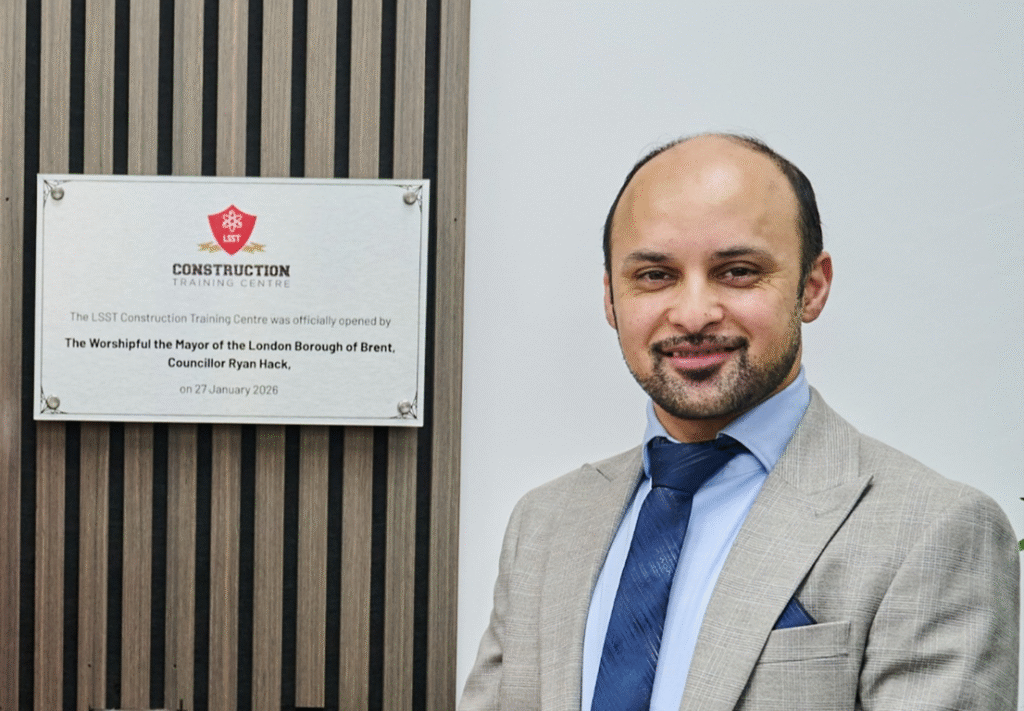
The programme is delivered at LSST’s purpose-built Construction Training Centre at Wembley, which was opened earlier this year by the Mayor of Brent.
The facility has 10 training bays to accommodate more than 20 learners and has been designed to provide an inclusive environment where adults can develop practical skills in a setting that reflects the workplace.
For learners, there is also a clear next step. Successful participants will be supported to progress towards completing their CSCS Green Card, helping them move closer to working on construction sites.
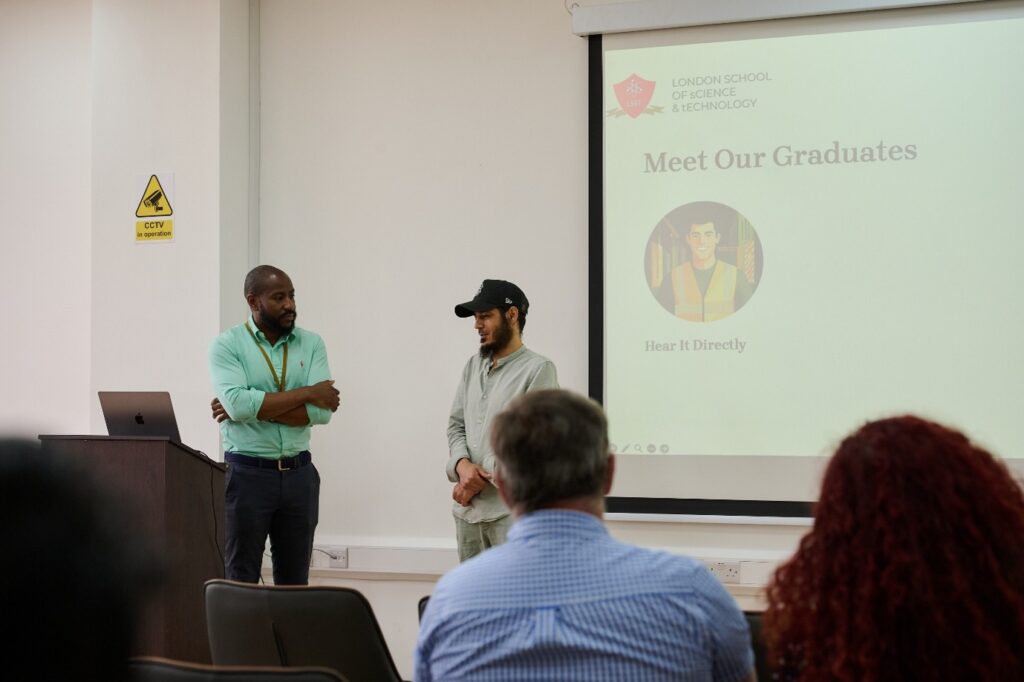
‘We expect to train around 200 or more adults this year,’ said Matt Garvey, Head of Further Education and Business Development at LSST. ‘We are partnering with some amazing employers who want skilled and reliable workers and our initial intake learners will visit building sites for guided tours as they become site-ready. It’s all part of the programme to build not just skills but behaviours like reliability, timekeeping, work ethic and willingness to learn that lead to jobs in construction.’
That focus on workplace behaviours is central to LSST’s approach. The aim is not simply to give learners a qualification, but to help them understand what employers are looking for and develop the confidence and practical experience to take their next step.
For some, that next step could be employment with a construction company. For others, it could be the beginning of working for themselves.
The next intake for the LSST Construction Skills Programme begins on Wednesday 28 October, with enrolments now open.
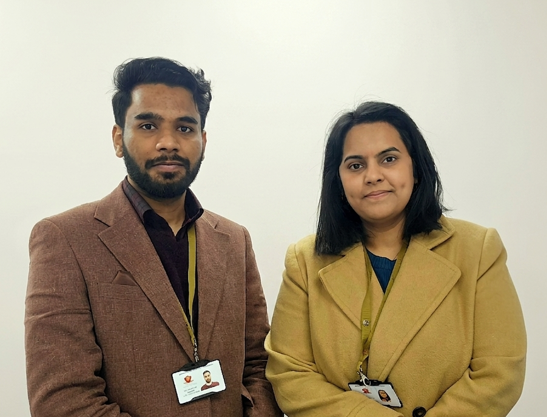
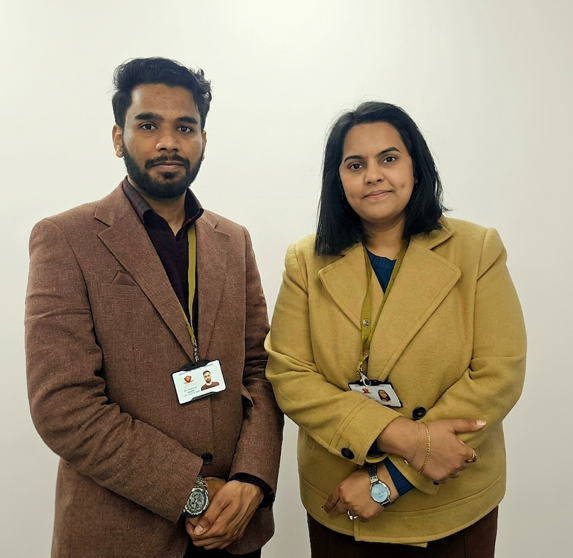
By Noor Mukhtar, Lecturer in Business (FHEA) (r) and Fateh Sher, Senior Student Support Officer (l) at LSST Luton.
A student sits down to write an assignment. Within seconds, AI can
generate an introduction, suggest references, and structure an argument. The temptation is obvious: why struggle with the first draft when a tool can create one instantly? But the harder question students need to ask themselves is: If AI does the thinking before I do, what exactly am I learning?
That question is becoming increasingly relevant across higher education. Many students are already using tools such as ChatGPT, Gemini, Copilot, or similar AI platforms. However, confidence in using these tools effectively, ethically, and critically does not always match usage.
Two Ways of Getting It Wrong (and How They Affect Your Career)
There are broadly two ways students respond to AI, and both can create significant hurdles for graduate employability:
The Avoidance Trap:Some students steer clear of AI entirely, either out of suspicion or a sense that using it somehow doesn’t count as “real” work. However, AI is already becoming part of everyday professional environments. From communication tools and design platforms to research databases and data analysis software, graduates will increasingly encounter AI-supported systems in the workplace.
Avoiding AI altogether does not protect independent thinking. Instead, it can mean entering employment without confidence in using technologies that employers increasingly expect professionals to understand.
The Over-Reliance Trap: The opposite extreme is allowing AI to complete the thinking process. A student who asks AI to create an assignment outline, generate a presentation, or produce an analysis without critically engaging with the output may save time, but risks losing the very process that develops valuable skills: analysing information, forming arguments, solving problems, and making decisions.
Employers are not looking for graduates who simply know how to ask AI to complete tasks. They need professionals who can work alongside AI — people who can provide direction, evaluate information, ask meaningful questions, and apply their own judgement.
Deep learning happens through active engagement: questioning, structuring ideas, revising, making mistakes, and understanding why something works (Biggs and Tang, 2011). Handing this entire process to AI can limit the development of independent reasoning and critical thinking skills (Zhai, Wibowo and Li, 2024).
What sits between avoidance and dependence is direction: learning to steer AI rather than defer to it.
Levelling the Playing Field: Digital Equity at LSST
AI literacy is not simply an individual responsibility. Students start their degrees with different levels of digital confidence, access to technology, and previous experiences with digital tools.
If AI skills are treated as something students should already know,
technology risks becoming another dividing line where digitally confident users progress faster while others are left behind.
By embedding AI literacy into academic and career support, it becomes a levelling skill — ensuring all students have the opportunity to develop the digital confidence, critical thinking, and adaptability needed for future employment.
Generative AI has significant potential to support learning, personalise assistance, and improve productivity, but only when used thoughtfully (Kasneci et al., 2023). Without critical engagement, AI can produce responses that are generic, outdated, incomplete, or inaccurate.
At LSST, the aim is not simply to teach students how to use AI tools, but to help them understand when, why, and how to use them effectively.
AI Doesn’t Understand – It Predicts
To use AI professionally, you have to understand what it actually does. AI does not “understand” concepts through experience or human reasoning. It understands concepts through experience, reasoning, or human judgement. Instead, it generates responses by identifying patterns from large amounts of existing data.
This means AI can be a powerful support tool, but it is not automatically reliable. It may produce incorrect information, fabricated references, or responses that appear convincing without being accurate.
The quality of AI output depends heavily on the quality of human input.
This is why future professionals need more than technical ability. They need the ability to question, evaluate, and improve what AI produces.
Building AI Confidence at LSST: Working With AI, Not Against It
At LSST, developing digital confidence is part of supporting student
success. Through classroom discussions, academic support, skills development sessions, and conversations around responsible technology use, students are encouraged to build confidence in engaging with emerging tools ethically and effectively.
From the start, students are introduced to the idea that AI should support learning rather than replace it. Students are encouraged to explore practical uses of AI, including brainstorming ideas, breaking down complex concepts, exploring alternative perspectives, creating study plans, and developing learning roadmaps.
However, students are also guided to understand the limitations of these tools. AI does not have personal experiences, independent ideas, or professional judgement. While it can provide suggestions and support learning, it cannot replace the human skills that shape meaningful education, such as interpretation, creativity, reflection, and decision-making.
If students rely on AI to generate responses without adding their own thinking, they risk producing generic work and missing opportunities to develop their own perspectives. Independent learning requires active engagement, questioning ideas, evaluating information, and making informed decisions.
At LSST, the aim is to help students become confident AI users who know when to use AI, when to question its responses, and when their own judgement must take priority.
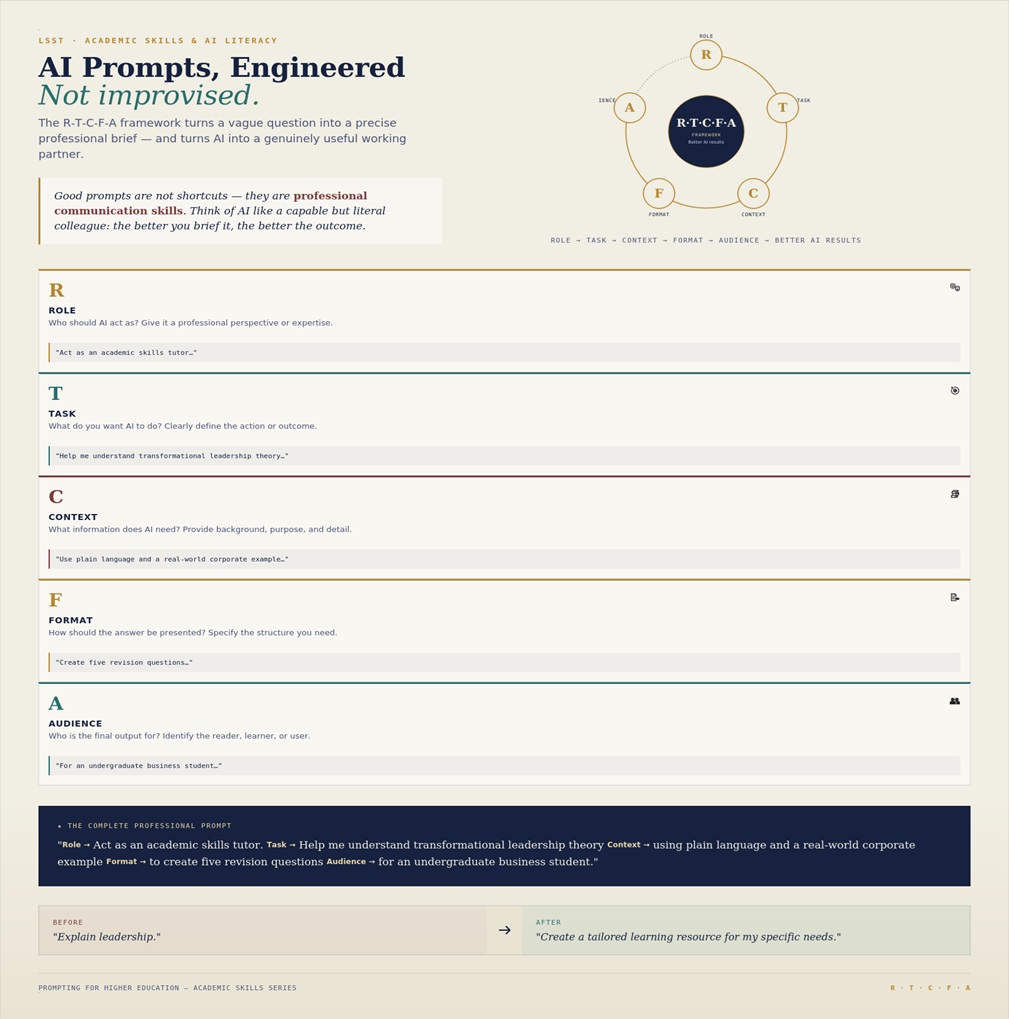
Mastering the R-T-C-F-A Prompting Framework
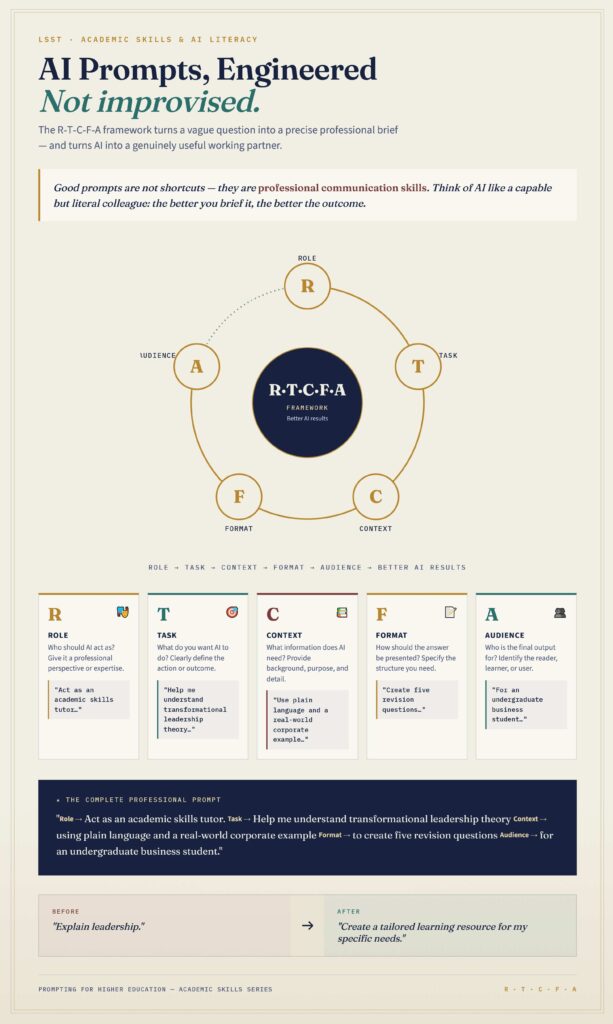
Poster created using ChatGPT (OpenAI) with AI-assisted design generation.Poster created using ChatGPT (OpenAI) with AI-assisted design generation.
Prompting is a genuine professional skill, not a shortcut. Think of it less like typing a Google search and more like briefing a capable but literal colleague. To get the best results, structure your instructions using the R-T-C-F-A framework:
Role: Give the AI a persona.
Task: Clearly define what needs to be done.
Context: Provide the background details.
Format: Specify how the output should look (bullet
points, email, essay).
Audience: Define who the final output is for.
The Professional Prompt in Action: “Act as an academic skills tutor [Role]. Help me understand transformational leadership theory [Task]
using plain language and a real-world corporate example [Context] to create five revision questions [Format] for an undergraduate business student [Audience].”
Precise instructions transform a generic response into a tailored and more effective study aid.
Knowing When to Doubt the Answer
In the workplace, employers don’t just value people who can generate ideas; they value people who can spot mistakes.
Generative AI tools are also known to “hallucinate”, producing convincing responses that may contain fabricated facts or non-existent academic references. For LSST students preparing for professional careers, this creates an important responsibility: becoming evaluators of information, not simply consumers of it.
Treating an AI response as a first draft- one that must be checked,
questioned, and improved is one of the most valuable habits graduates can develop for their future careers.
Speed Isn’t the Same as Progress
One of the biggest misconceptions is that AI is only valuable if it makes tasks faster. But efficiency and deep learning are often at odds. A student who spends thirty minutes questioning, restructuring, and correcting an AI-generated response will come away understanding far more than a student who spends five minutes copying a finished answer. Learning requires friction. Take the friction out entirely, and you take away the opportunity to grow.
Why This Matters Beyond the Degree?
Ultimately, your course is not just about completing assignments. It is about developing the skills students will carry into the workforce.
Technology will continue to evolve faster than any university can teach every specific tool graduates may encounter throughout their careers. What higher education institutions can develop is something more valuable: adaptability.
Employers need professionals who can learn new systems, communicate effectively with technology, and make sound, ethical decisions using the information and tools available to them.
The future worker is not someone competing with AI. It is someone who knows how to combine their own uniquely human judgement, critical thinking, creativity, empathy, and adaptability with what technology can offer.
The question for LSST students is not whether AI will be part of their
future. It already is.
The real question is whether they will use it passively or purposefully.
The graduates who succeed will not be those who let AI think for them. They will be those who have learned how to think alongside it.
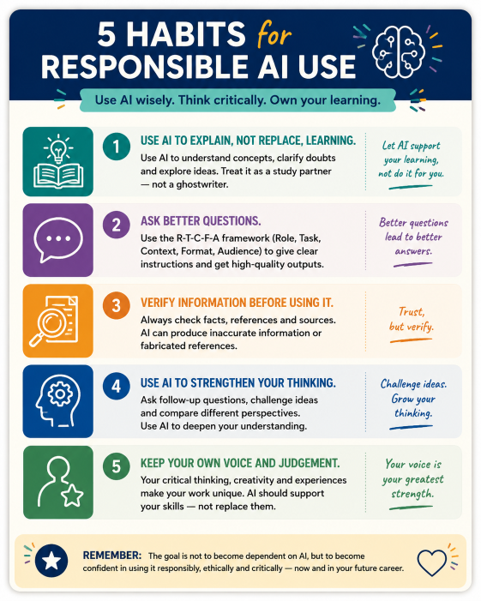
5 Habits for Responsible AI Use
1. Use AI to explain, not replace, learning: Use it as a personal
tutor, not a ghostwriter.
2. Ask specific questions with clear context: Use the R-T-C-F-A
framework to get high-quality outputs.
3. Check facts and references before using information: Never assume an
AI’s output is 100% accurate.
4. Use AI to improve your thinking, not avoid thinking: Use the
back-and-forth dialogue to challenge your own assumptions.
5. Keep your own voice and judgment: Always keep your unique
perspective at the absolute centre of your work.
Poster created using ChatGPT (OpenAI) with AI-assisted design generation.
References
Biggs, J. and Tang, C. (2011)
Teaching for Quality Learning at University. 4th edn. Maidenhead: Open University Press.
Kasneci, E. et al. (2023) ‘ChatGPT for good? On opportunities and
challenges of large language models for education’,
Learning and Individual Differences, 103, 102274.
Zhai, X., Wibowo, S. and Li, L. (2024) ‘The effects of
over-reliance on artificial intelligence dialogue systems on critical
thinking and learning’, Educational Technology Research and Development.
Professor Mahmuda Begum: from pioneering research to professorship – a remarkable journey in higher education. Photo: LSST.
Look across the higher education landscape and you will rarely find an educator whose credentials so directly bridge cutting-edge research and transformative classroom learning. Holding a PhD, MPhil, MBA, multiple master’s degrees – and a Senior Fellowship with the Higher Education Academy (SFHEA) – Professor Mahmuda Begum has dedicated her 18-year academic career to one core mission: empowering students through innovative and inclusive higher education pedagogies.
Now, the Ministry of Education in Bangladesh has recognised her outstanding contributions to higher education by awarding her the title of Professor of Management.
The official promotion marks a major milestone in a career defined by international scholarly leadership. Under a formal government Lien for Overseas Employment scheme, Professor Begum brings high-level governance and research directly into the classroom – serving as Senior Lecturer in Business at LSST Birmingham while maintaining senior academic leadership roles at National University in Bangladesh.
Elevating the Student Experience
On campus, Professor Begum’s impact extends far beyond traditional lectures. Sitting on LSST’s Research Ethics Committee, she ensures ethical practice and academic integrity are embedded across disciplines. Her research actively shapes modern teaching practices with a clear focus on higher education management pedagogies, Equality, Diversity and Inclusivity (EDI) frameworks, academic leadership capability and sustainable business models.
Beyond campus, she is a prominent voice in UK academic governance, regularly serving as a Session Chair (for Strategy and Leadership Development) and Peer Reviewer for the British Academy of Management (BAM), as well as an Abstract Reviewer for the British Educational Research Association (BERA).
“Academia today cannot exist in an isolated bubble,” says Professor Begum. “Whether I am evaluating research at BAM or BERA or guiding LSST students, my goal is to translate rigorous theory on EDI, sustainability and educational strategy directly into classroom practice. I am deeply honoured by this professorship and grateful to both National University and LSST as we continue to inspire students to achieve their fullest potential.”
Cross-Border Leadership
Her elevation to full Professorship – complemented by a strategic posting as Officer on Special Duty (OSD) at the Directorate of Secondary and Higher Education in Dhaka – exemplifies cross-border expertise that directly enriches student learning.
Mr Ali Jafar Zaidi, CEO of LSST, said:
“We are immensely proud of Professor Begum’s extraordinary accomplishments. LSST has always strived to build an environment where world-class educators bring real-world insight straight into the classroom. Her dual appointment as a professor and policy advisor in Bangladesh while leading lectures at LSST exemplifies the empowered mindset we aim to instil across our entire student community.”
Mohsin Riaz, Dean of LSST Birmingham, said:
“Professor Begum embodies the calibre of teaching and academic leadership that defines LSST. Her elevation to full Professor is a well-deserved recognition of her dedication to educational quality. Having a scholar of her stature guiding our students ensures they aren’t just learning standard business models – they are learning from someone actively shaping global strategy and policy.”
Professor Begum is currently advancing several key studies scheduled for publication through late 2026. Her forthcoming research explores work climates for inclusive education (Teacher’s World, Oct 2026), developing inclusive learning and teaching practice in UK HEIs (IJBM, Nov 2026), dark leadership behaviour patterns (IJBM, Dec 2026) and training evaluation models (IJSSHMR, Dec 2026).
Professor Begum’s Publications
Begum, M., 2026. Reducing dark leadership in the public sector: A grounded theory study from Bangladesh. International Journal of Business and Management, 5(2), pp. 1335–1353. https://doi.org/10.56879/ijbm.v5i2.118.
Begum, M., Islam, M. F., Mahmood, I., and Sam-Sorungbe, O., 2025. Stakeholder integration in sustainability-oriented innovation: An approach to sustainable business model in SME within the UK. International Journal of Small and Medium Enterprises, 8(1), pp. 42–50. https://doi.org/10.46281/ijsmes.v8i1.2693.
Sam-Sorungbe, O., Mahmood, I., Olori, E.F., and Begum, M., 2025. Breaking barriers or building bridges? A systematic review of women entrepreneurship in SMEs within emerging economies. International Journal of Small and Medium Enterprises, 8(1), pp. 14–26. https://doi.org/10.46281/ijsmes.v8i1.2654.
Begum, M., 2025. The collaborative dialogue for the cooperative and inclusive learning: A study within the context of higher education in the UK. BERA Conference paper. BERA Conference 2025, University of Sussex, UK.
Begum, M., 2024. Resource integration and dynamic capability for firms’ sustainable competitive advantages through business digital transformation: An instrumental case study within the context of incumbent firms in the UK. ISBN: 978-9- 9956413-7-2. https://www.xcdsystem.com/bam/program/wZFOZki/index.cfm?pgid=1763
Begum, M., 2020. Evaluating training programmes: A grounded theory exploration of training evaluation as experienced by managers working in the textile industry in Bangladesh and the development of a new approach for the evaluation of training within that context. PhD thesis. University of Wales Trinity Saint David. Available at: https://repository.uwtsd.ac.uk/id/eprint/1438/
For further details or media inquiries, contact LSST’s Public Relations Manager viakunal.mehta@lsst.ac.
Enjoyed reading LSST News? Discover your path and explore opportunities across our academic community atwww.lsst.ac/coursesor viaadmissions@lsst.ac. Think Further. Think Higher. Think LSST.
Leading maternal health forward: Dr Suhirthakumar Puvanendran on his latest genomic study exploring cell-free RNA for early pre-eclampsia risk. Photo: LSST.
In a landmark contribution to maternal health and genomic science, a new study led by Dr Suhirthakumar Puvanendran, Lecturer in Health & Social Science at LSST Elephant & Castle, has identified gestational week 13 as a potential molecular window for studying the early biological signs of pre-eclampsia (a pregnancy related condition that usually develops after 20 weeks and involves the new onset high blood pressure).
Published in the journal Placenta (viaScienceDirect), the study titled “Gestational Week 13 – a Critical Window for Pre-Eclampsia Pathogenesis: A Cell-Free RNA Gene Expression Study” offers critical insights into how the condition develops long before clinical symptoms appear.
Looking Beyond Clinical Diagnosis
Pre-eclampsia affects millions of pregnancies worldwide. Traditionally, it is diagnosed only after the 20th week of pregnancy, when clinical signs such as high blood pressure become apparent. However, the biological processes contributing to pre-eclampsia begin much earlier.
By analysing cell-free RNA (small fragments of genetic material circulating freely in the mother’s blood), Dr Puvanendran discovered that the strongest disruption in gene expression associated with pre-eclampsia occurs around gestational week 13.
“Pre-eclampsia is generally diagnosed after 20 weeks of gestation, when
clinical signs such as high blood pressure and other associated abnormalities become apparent,” says Dr Suhirthakumar Puvanendran. “However, the biological processes contributing to pre-eclampsia may begin much earlier. Our research suggests that gestational week 13 may represent an important molecular window for identifying early biological changes associated with pre-eclampsia. By studying cell-free RNA, small fragments of RNA circulating in the mother’s blood, we found that the strongest disruption in gene expression associated with pre-eclampsia occurred around this stage. The finding shifts attention towards a period before pre-eclampsia is normally diagnosed clinically and suggests that week 13 could be an informative point for investigating molecular signals associated with future disease risk.”
Because cell-free RNA can be studied from a simple blood sample, this approach raises the possibility of developing future non-invasive methods (simple tests that do not harm the baby or require surgery) for earlier risk assessment. However, Dr Puvanendran emphasises that more research is essential before this can be used in clinics:
“Importantly, our study does not mean that pre-eclampsia can currently
be diagnosed at week 13 using cell-free RNA. Further research and
validation in larger, prospective clinical studies are needed to
determine whether these molecular changes can reliably predict
subsequent pre-eclampsia. In the longer term, identifying molecular
changes around week 13 could potentially provide healthcare
professionals with an earlier opportunity to assess risk, tailor
monitoring and consider appropriate interventions where evidence
supports them.”
Bridging Research
The study highlights LSST’s expanding research capacity, demonstrating how computational biology (using computers and data to solve complex biological problems) can address pressing health challenges while enriching the learning environment for students.“What drives me is the opportunity to use computational biology, genomics and data science to address important challenges in human health,” adds Dr Puvanendran. “My research aims to understand the early molecular changes associated with pre-eclampsia and explore how these insights could contribute to earlier detection and more personalised healthcare. My role at LSST has provided a supportive academic environment that allows me to develop my
research alongside teaching, while working with colleagues and students
across health and social science has strengthened my ability to
communicate complex scientific ideas and connect research with
real-world healthcare challenges.”
Mr Ali Jafar Zaidi, CEO of LSST, said:
“This outstanding publication in ScienceDirect reflects the exceptional
research calibre cultivated at LSST. Dr Puvanendran’s work addresses a
global health priority and demonstrates our commitment to life-changing
academic inquiry.”
Syed Rizvi, Dean of Learning and Teaching and Academic Dean
of LSST Elephant & Castle and LSST Stratford, said:
“Dr Puvanendran’s study exemplifies academic excellence. Integrating
world-class data science into our higher education teaching inspires our
students to lead innovation in healthcare in real-time.”
Mrs Eniana Gobuzi, Associate Dean at LSST Elephant &
Castle, added:
“We are proud to celebrate our ongoing published achievements at
Elephant & Castle. Dr Puvanendran’s research reinforces our
dedication to impactful and research-informed teaching that directly
benefits public health and student learner journeys.”
Puvanendran, S. and Brew, O. (2026) ‘Gestational week 13 – a critical window for pre-eclampsia pathogenesis: A cell-free RNA gene expression study’, Placenta, 183, pp. 166–176. doi:
10.1016/j.placenta.2026.09.008
.
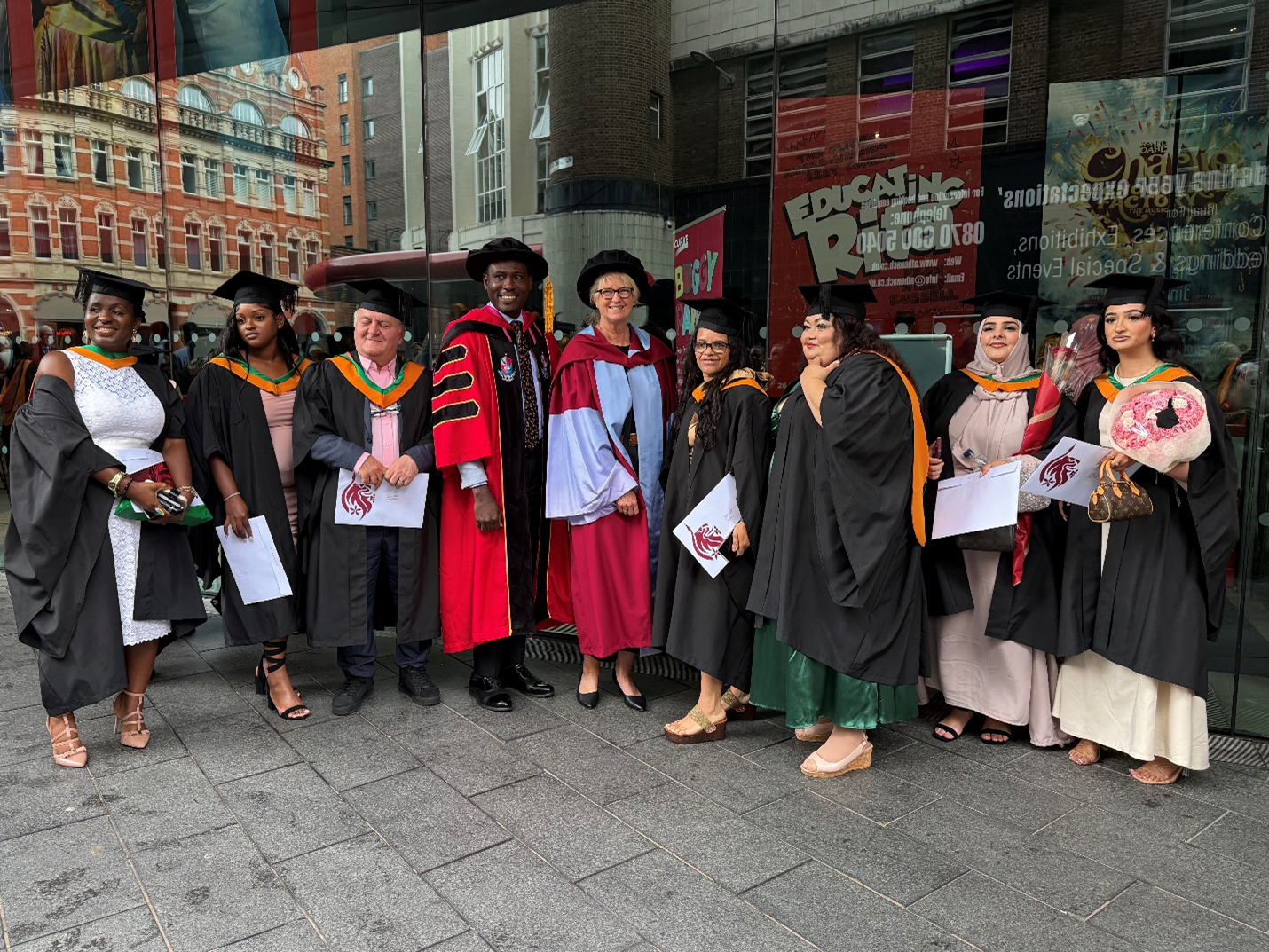
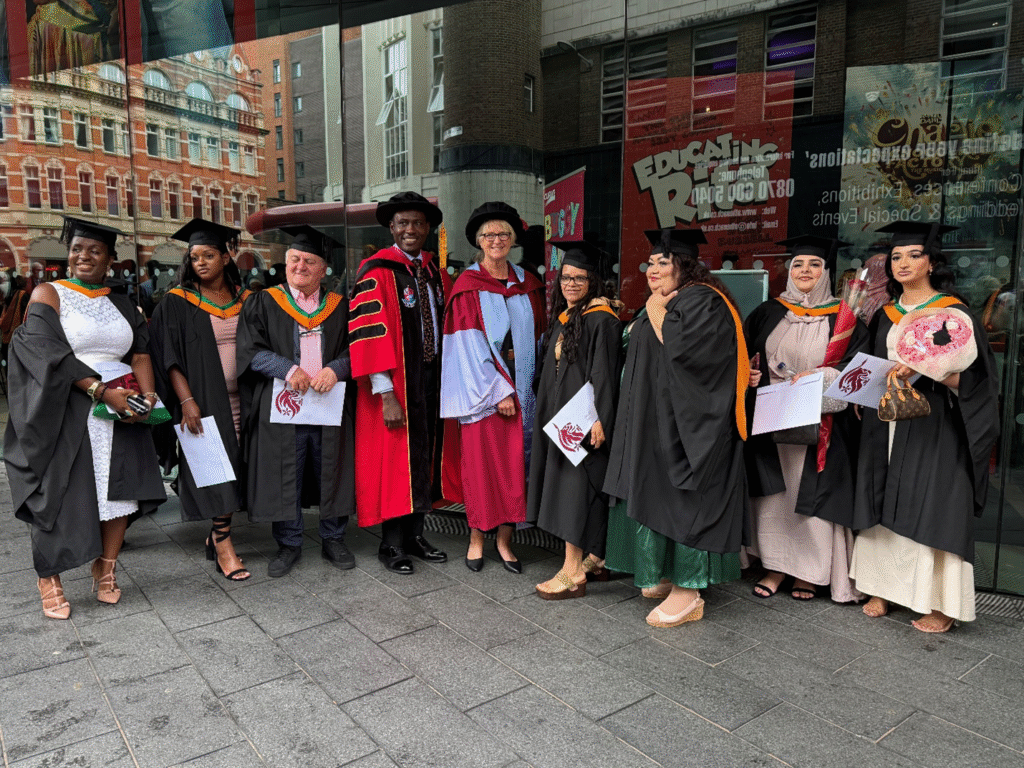
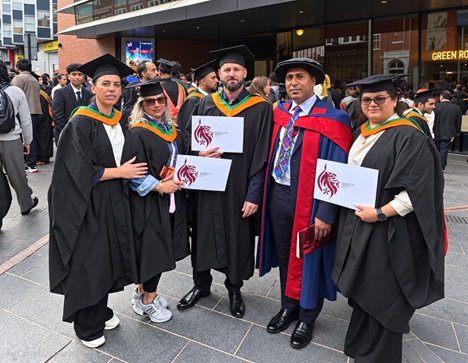
Dr Wendy Wigley, He ad of Student Lifecycle (fifth from left) and Dr Michael Demehin, Senior Lecturer and Course Coordinator at LSST Birmingham (fourth from left), celebrate with graduates outside the Curve Theatre in Leicester. Photo: LSST.
Business and Health students across LSST’s campuses have officially crossed the graduation stage, celebrating an exceptional wave of academic success through the institution’s partnership with De Montfort University (DMU). Gathering in Leicester at the iconic Curve Theatre, graduates received their degrees surrounded by family, friends and academic mentors – turning years of dedication, late-night study and relentless ambition into degree qualifications and life-changing graduate outcomes.
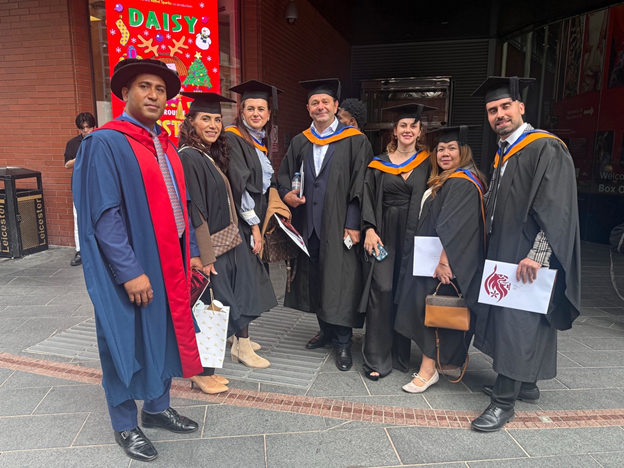
Dr Muhammad Haque, Senior Lecturer at LSST Wembley (left) and Mrs Farzaneh Rezaee, Course Coordinator and Senior Lecturer at LSST Wembley (second left), with LSST Wembley Business Management graduates outside the Curve Theatre in Leicester. Photo: LSST.
Reflections on Graduate Success
Mr Ali Jafar Zaidi, CEO of LSST, praised the graduating
classes for their dedication:
“Seeing our DMU-validated cohort cross the stage is a profound moment for everyone at LSST. Graduation represents the ultimate culmination of courage and commitment. It reflects not only our students’ academic rigour but their vision for the future. We take immense pride in standing alongside them as they step into exciting new chapters filled with potential.”
Professor Katie Normington, Vice-Chancellor of De Montfort
University, said: “To see students graduate is always a privilege, and this cohort’s achievement stands out for the dedication it took to get here. Congratulations to each and every one of you – this moment belongs to you, and I hope it’s the first of many milestones still to come.”
Charlie Tennant, LSST’s Vice Principal, added:
“This graduation stands as living proof of LSST’s mission to illuminate lives through inclusive and exemplary higher education. Our graduates leave not just with degree qualifications but equipped with the critical thinking and leadership skills required to innovate and lead in modern industry.”
Baheer Peerzada, Course Coordinator and Senior Lecturer at LSST Luton (fifth from right), and Mrs Farzaneh Razaee, Course Coordinator and Senior Lecturer at LSST Wembley (fourth from right), with LSST Business Management graduates. Photo: LSST.
Empowering Learners
Dr Wendy Wigley, Head of Student Lifecycle and Partnership Manager at LSST, highlighted the transformative nature of student journeys:
“True higher education partnerships are measured by the lives they transform and the journeys they sustain. From their very first day through to crossing the graduation stage, watching our cohorts evolve into high-achieving and confident professionals has been extraordinary.”
Syed Rizvi, Dean of Learning and Teaching and Academic Dean
of LSST Elephant & Castle and LSST Stratford, reflected on teaching
excellence: “Great teaching does not simply deliver a curriculum – it builds confidence and sparks curiosity. Watching our students develop from their initial foundation studies into scholars capable of producing top-tier academic work has been extraordinarily rewarding. Their success is a testament to what can be achieved when innovative learning and teaching strategies are centred
around student success.”
Aasfieq Moosa, LSST’s Student Union President, spoke on
behalf of the student body: “I am immensely proud to represent a student community so full of ambition, heart, and determination. Watching our peers reach this landmark milestone – and securing such outstanding academic results – is deeply inspiring for all
of us. The future is brighter because of what our new graduates bring to it.”
Business Management graduates celebrating their First-Class Honours results outside Curve Theatre in Leicester. From right: Ioana Țicu (75% overall grade), Dr Muhammad Haque (Senior Lecturer, LSST Wembley), Mihai Rusu (70%), Daniela Mafti (71%) and Alexandra Mihaela Rosu (72%).
Dr Muhammad Haque, Senior Lecturer at LSST Wembley, who
attended the ceremony, said: “Witnessing our students graduate was an immensely proud moment. Having supported many of them from their early undergraduate days through to completion, I have watched them develop into confident and independent thinkers. Their success belongs entirely to them – they put in the work,
overcame every challenge and earned their degrees.”
For further details or media inquiries, contact LSST’s Public
Relations Manager via kunal.mehta@lsst.ac.
Enjoyed reading LSST News? Discover your path and explore
opportunities across our academic community at www.lsst.ac/coursesor viaadmissions@lsst.ac. Think Further. Think Higher. Think LSST.
Delegates and leaders gather at LSST Birmingham for a landmark BSA event celebrating collaborative research and innovation in non-traditional learning. Photo: LSST.
LSST Birmingham became a national focal point for pedagogical innovation by hosting the British Sociological Association (BSA) Early Career Regional Event (3 Sep 2026). Convened under the banner “Educating the Non-Traditional Learner: The Want, The Need, and The Demand for Inclusive Learning in the 21st Century,” the symposium moved beyond diagnosing present educational challenges to chart an ambitious blueprint for the future of tertiary study.
The event was made possible after Dr Michael Demehin, Senior Lecturer and Course Coordinator at LSST, secured the British Sociological Association Early Career Regional Event Grant 2026 following a competitive national selection process earlier in the year.
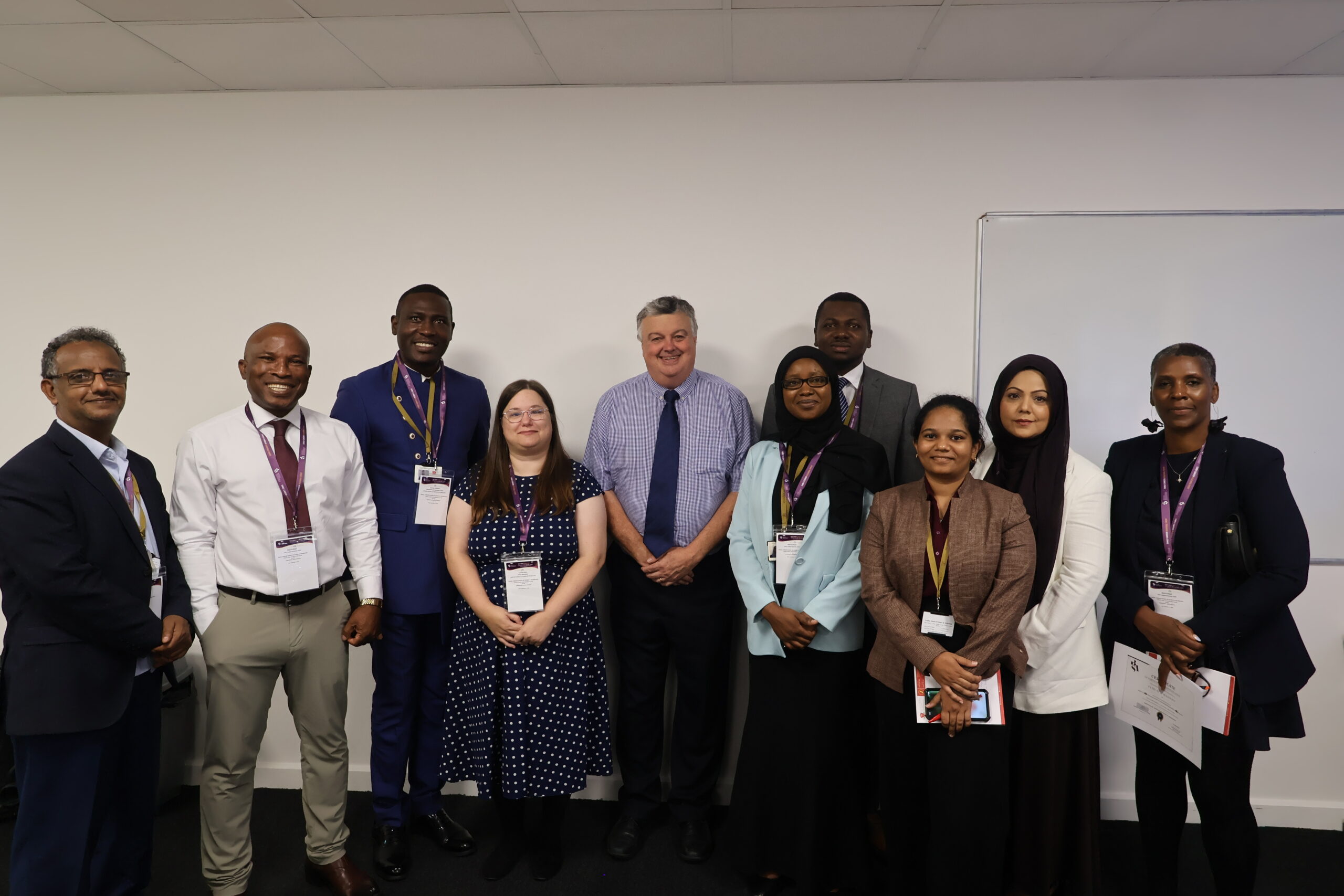
(l-r), Dr Michael Demehin, Senior Lecturer and Course Coordinator at LSST Birmingham, Samina Shafieq, Careers and Employability (HE) and Programme Manager (FE) at LSST Birmingham and Professor Paul McDermott, Principal of LSST. Photo: LSST.
Following a call for papers, the event brought together delegates from across the sector, including the University of Wolverhampton, Fairfield School of Business, CECOS College, UK Management College, and UK Business College, as well as representatives from regulatory bodies such as Ofqual.
Across the sessions, scholars engaged with emerging frontiers in higher education. Discussions covered the much-needed calibration of generative AI policies, digital equity for adult returners, mental wellbeing in teaching delivery and explainable AI applications created to support neurodiverse learners.
Hileni Amuthenu, Lecturer in Health at LSST Birmingham (centre), with Dr Michael Demehin, Senior Lecturer and Course Coordinator at LSST Birmingham (l), and Professor Paul McDermott, Principal of LSST (r). Photo: LSST.
Leadership and Strategy
Addressing the long-term strategic trajectory of the sector, the event highlighted that higher education must proactively adapt to shifting student demographics, evolving labour markets, as well as rapid technological acceleration.
“Higher education cannot fulfil its civic mandate if it remains bound to legacy structures designed for a bygone era,” said Ali Jafar Zaidi, CEO of LSST. “Hosting this British Sociological Association event at LSST Birmingham reinforces our commitment to transforming widening participation from a policy standpoint into a catalyst for systemic transformation. By pioneering research into the non-traditional learner experience, we are not merely expanding access today – we are designing the forward-looking academic models required for tomorrow’s workforce.”
Heather Price, Lecturer in Business at LSST Birmingham, with Dr Michael Demehin, Senior Lecturer and Course Coordinator at LSST Birmingham (l), and Professor Paul McDermott, Principal of LSST (r). Photo: LSST.Odoligie Imarhiagbe, Senior Lecturer and Course Coordinator in Health at LSST Birmingham (centre), with Dr Michael Demehin, Senior Lecturer and Course Coordinator at LSST Birmingham (l), and Professor Paul McDermott, Principal of LSST (r). Photo: LSST.
In his keynote address, “Institutional Leadership and the Future of Inclusive Learning in UK Higher Education,” Professor Paul McDermott, Principal of LSST, framed inclusivity as the definitive strategic obligation for modern higher education.
“The UK higher education sector stands at a generational turning point,” said Professor Paul McDermott, Principal of LSST. “Inclusivity can no longer be treated as a peripheral compliance metric; it must serve as the primary engine of institutional evolution. True widening access demands that we fundamentally rethink our learning environments – building ecosystems where every student, regardless of their background or pathway, experiences deep intellectual challenge, belonging and independent thinking. It is the role of senior leaders to ensure that inclusivity is embedded across all strategic priorities, evidenced and measured to allow for continuous improvement. If not, it stays as a tokenistic reactable gesture.”
Roland Iuga, IT Staff at LSST Birmingham, with Dr Michael Demehin, Senior Lecturer and Course Coordinator at LSST Birmingham, and Professor Paul McDermott, Principal of LSST. Photo: LSST.
“Hosting a conference of this calibre at LSST Birmingham highlights the vitality of our academic community and our commitment to scholarship that engages with real-world value,” added Mr Mohsin Riaz, Dean of LSST Birmingham. “Empowering non-traditional learners lies at the very heart of our mission in Birmingham. Bringing together leading thinkers across the UK to explore inclusive pedagogy ensures that LSST remains at the vanguard of educational transformation and student success.”
Dr Michael Demehin presented his research, “Sociological Analysis of Feedback in Higher Education: A Brick Trowel or Knife?”, analysing how academic assessment feedback can function either as a constructive foundation for student growth or as an unintended barrier for non-traditional cohorts.
“Securing the BSA Regional Event grant provided a vital platform to subject the evolving student experience to rigorous sociological inquiry,” said event organiser Dr Michael Demehin. “The depth of dialogue across our session – from AI-driven inclusion to novel retention frameworks – shows a sector-wide readiness to build a more agile and equitable future for higher education.”
“Bringing together scholars across the UK highlights the vital role practice-focused research plays in transforming higher education,” said Dr Maryam Idris-Usman and Dr Ned of the LSST Research Centre in a joint statement. “Our focus is to move beyond theory and build evidence-based frameworks that empower non-traditional learners. The insights from this event will directly inform our ongoing research initiatives while ensuring inclusive practice creates lasting student success.“
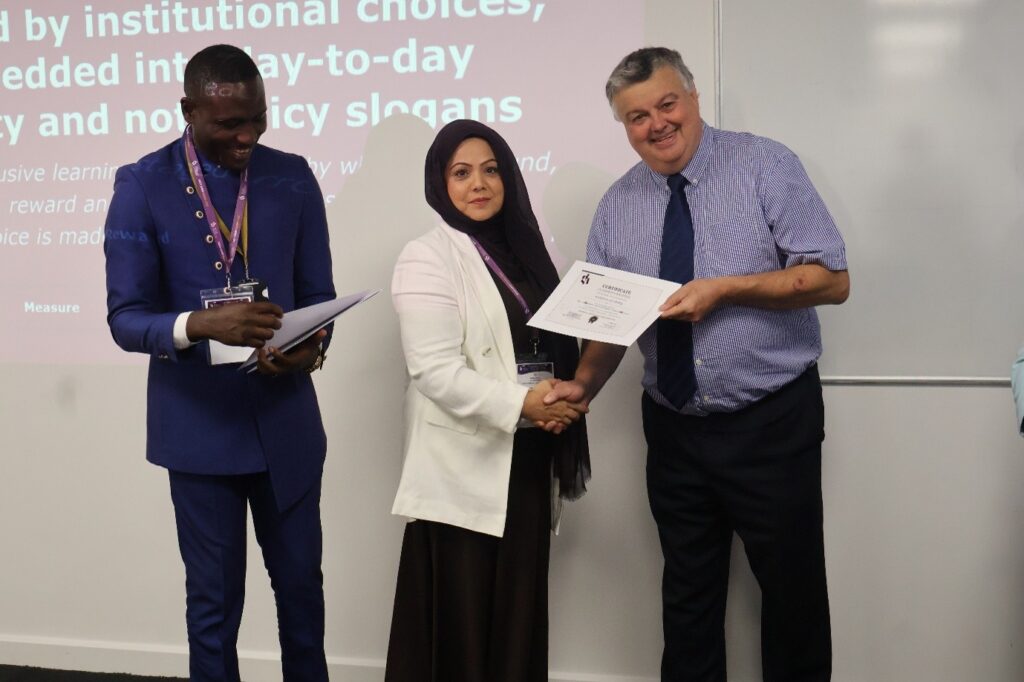
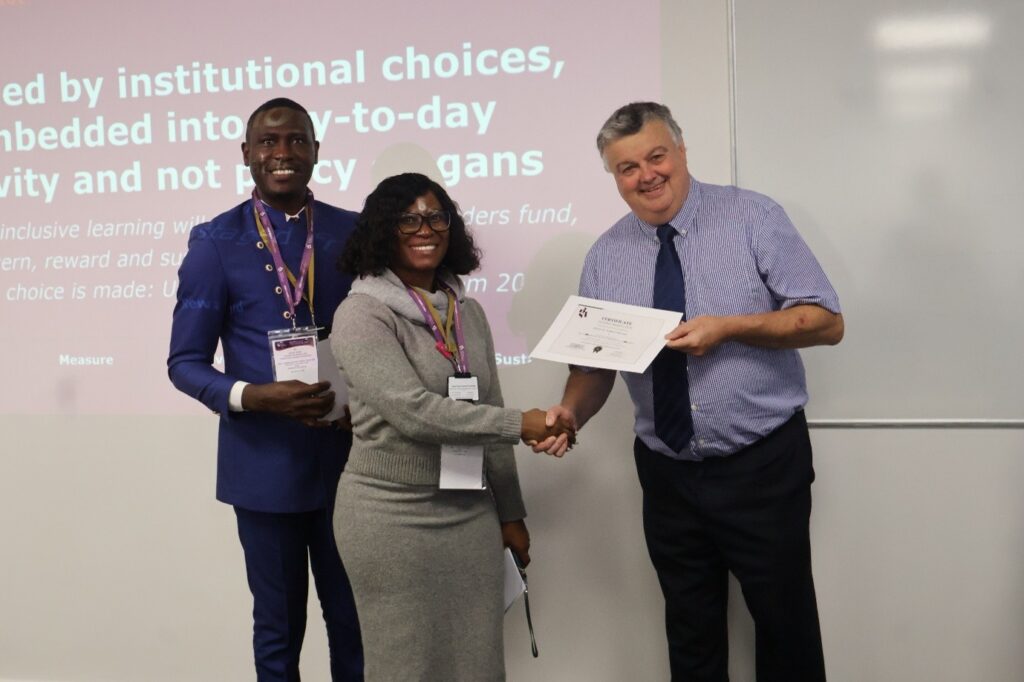
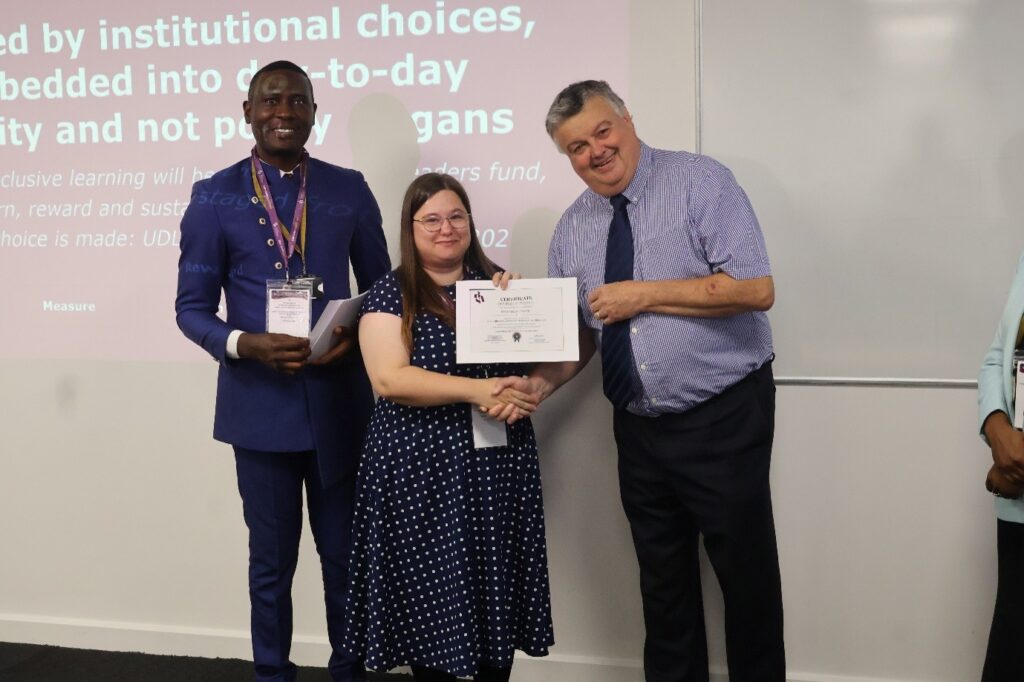
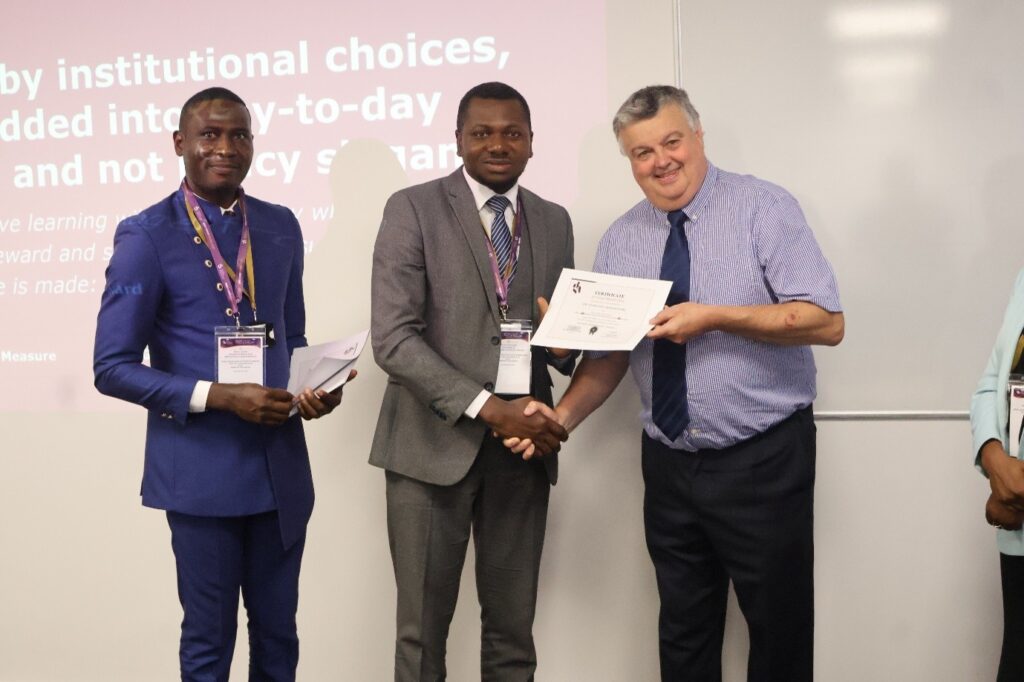
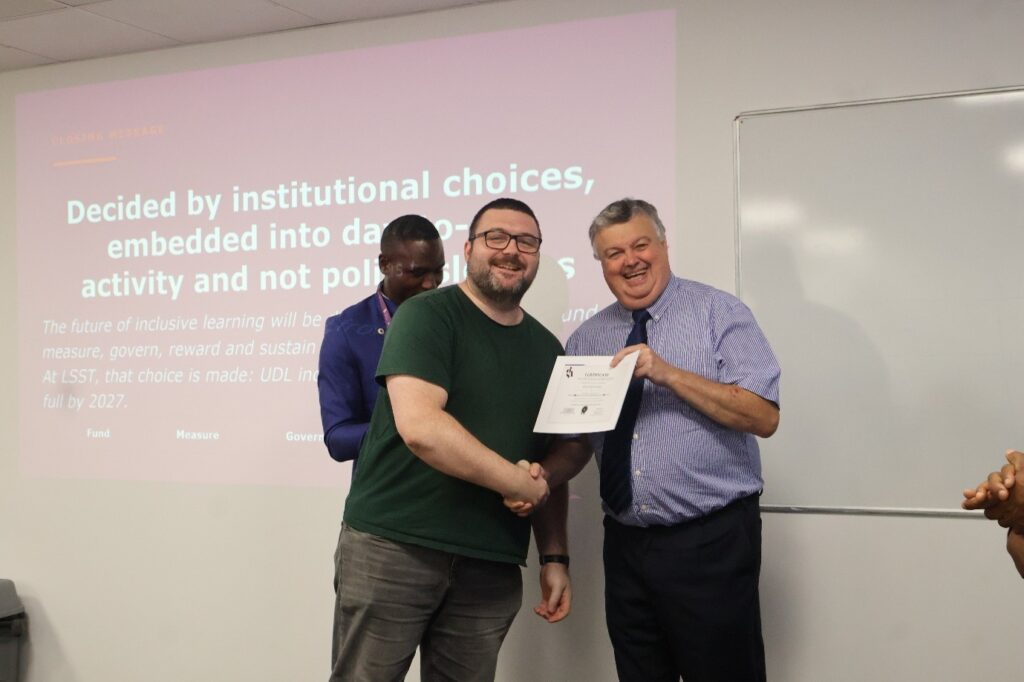
The symposium concluded with an award ceremony, where Dr Michael Demehin, Professor Paul McDermott and LSST Research Centre officials Dr Maryam Idris-Usman and Dr Ned presented certificates of presentation and participation to delegates. Delivering closing remarks, Dr Maryam Idris-Usman emphasised that the event marks the launch of ongoing collaborative research networks aimed at translating conference outcomes into scalable pedagogical practices across the UK higher education landscape.
We hope you enjoyed reading LSST News. Join our vibrant academic community and explore endless opportunities for growth and learning at www.lsst.ac/coursesor via admissions@lsst.ac. Discover your path at LSST and embark on a transformative educational journey today. Think Higher. Think Further. Think LSST.
For additional information or interviews, please direct questions to LSST’s Public Relations Manager and Editor ofLSST Lifeviakunal.mehta@lsst.ac.
Academic integrity, due process, and institutional learning
A higher education governance reflection arising from the case of Professor Jason Arday.
By Dr Muhammad Emdadul Haque (SFHEA, NCEE), Senior Lecturer at LSST Wembley
CONTENT NOTE
This article addresses bereavement, mental health, and a recent death. Please consult a trusted contact or Medical Practitioner if affected by these themes or experiencing mental health difficulties. Samaritans, Mind, and NHS mental health services are also sources of support. In situations of danger or urgent medical need, contact emergency services or attend your local Accident & Emergency department.
CASE CONTEXT AND EVIDENTIAL BOUNDARIES
Distinguishing bereavement, academic processes, and institutional review
Professor Jason Arday died aged 41 on 14 August 2026. While his death is a matter of profound sadness for those who knew him, it is treated separately here from the academic and institutional processes that preceded it. Those processes involved distinct questions relating to his publications, qualifications, honorary appointments, and tenure at the University of Cambridge. This article examines the implications of those processes for governance and accountability in higher education, while carefully distinguishing between allegations, reviews, investigations, findings, and outcomes (Hui, 2026; University of Cambridge, 2026a, 2026b, 2026c).
CASE STATUS NOTE – FOUR DISTINCT STRANDS
1. Thesis and journal-publication allegations. Cambridge made an announcement on 2nd August that “investigations of complaints about Arday’s PhD thesis and the publication of certain research papers” have been conducted by LJMU and the concerned journals. From the Guardian news report, it appears that “the LJMU investigation rejected the allegation of plagiarism but found the mistakes to be honest and reasonable mistakes”. This finding is not to be taken as settling other concerns raised later (University of Cambridge, 2026a; Adams & Bakare, 2026).
2. Qualifications and honorary titles. Following the receipt of new information relating to Arday’s qualifications and honorary titles, on 5 August, Cambridge University made known that another inquiry had been initiated (University of Cambridge, 2026b). It was further noted that other complaints regarding academic misconduct were being considered separately.
3. Appointment and time at Cambridge. On August 12, the Vice Chancellor informed the commencement of an investigation into the events leading up to the appointment of Arday in 2022 and the time he spent at Cambridge, with a view that the results of this investigation will contribute to a review of procedures for the appointment of senior academics.
4. Death and bereavement. Arday died in London on 14 August 2026, aged 41 years old. According to the police, the professor’s death is considered as unforeseen and does not seem to be a suspicious event. This article will not attribute causality between his death and any of the preceding controversies (Hui, 2026).
TABLE 1 | FACT BOUNDARIES
Question
What reliable sources establish
What cannot responsibly be concluded
Thesis and publication allegations
Cambridge University announced on 2 August that plagiarism allegations related to the thesis and some journal publications had been investigated by LJMU and the journals involved. Guardian News reported that the Liverpool John Moores University (LJMU) had not upheld plagiarism charges and attributed identified issues to honest and reasonable errors.
That every subsequent allegation or concern was solved by the previous process conducted by LJMU or that all journals arrived at the same finding.
Qualifications and honorary appointments
On 5 August, Cambridge University announced a new investigation into the latest information regarding academic qualifications and honorary appointments; it separately noted ongoing complaints about academic misconduct.
That the investigation process has already confirmed that any disputed qualification, appointment, or claim was false.
Appointment and time at Cambridge
On 12 August, the Vice-Chancellor announced a separate investigation into the circumstances regarding the 2022 appointment and Arday’s tenure at Cambridge. The investigation results are intended to inform a review of senior appointment process.
That Cambridge University had been found guilty of having made a mistake in due diligence or recruitment governance. The announced process should not be anticipated.
Death
Arday died in London on 14 August 2026, aged 41. Police describe the death as unexpected and not believed to be suspicious.
A causal link between the controversy and his death cannot responsibly be asserted unless established by competent authorities and evidence.
Sources: Adams and Bakare (2026); University of Cambridge (2026a, 2026b, 2026c); Hui (2026).
THE LESSON
01 Achievements, allegations, and due process
Jason Arday’s public record includes scholarship, activism, institutional recognition, and later controversy. In 2023, Cambridge University profiled Arday as an academic and advocate of race, inequality, and education working towards increasing access for disadvantaged groups. For analytical purposes, these aspects should be considered alongside, but not conflated with, the subsequent allegations and institutional questions (University of Cambridge Faculty of Education, 2023).
Scholarly work can contribute to the creation of new knowledge, robust policies, enhance the student experiences, and public confidence; thus, concerns about unacknowledged use of academic work such as ‘borrowing‘ or misrepresentation should be subject to rigorous analysis. At the same time, when concerns are raised, due process depends upon maintaining clear distinctions between allegations, suspicions, and findings, while recognising the evidential limits of any review or investigation. This is necessary to preserve confidence in both academic standards and institutional decision-making.
A proper institutional response must avoid oversimplification of any case into a dichotomy of either condemnation or defence. It should consider the evidence, distinguish honest errors from misconduct, provide an opportunity to respond meaningfully, correct the record where appropriate, and make conclusions proportional to the evidence identified.
ANALYTICAL STARTING POINT
A robust response should be exacting about both the quality of scholarship and the fairness, care and accuracy of the process used to assess it.
02 Integrity as a system of accountability and support
According to the 2025 principles of the UK Concordat, summarised in the UK Research Integrity Office (UKRIO) guide, the principles of integrity include honesty, rigour, transparency and open communication, care and respect, and accountability (UKRIO, 2025a). This wider notion is important as the evidence to be considered during any plagiarism disputes often requires careful consideration. The use of detection tools, screenshots and parallel-text comparisons can identify material requiring scrutiny, but such evidence alone is insufficient to determine intent, context, responsibility, or outcome. Likewise, concerns about the communication of allegations should be examined separately from the underlying scholarly issues. Each question demands evidence that is relevant and proportionate to the matter under consideration.
An institutional integrity system should bring together accountability, due process, and appropriate support. Its purpose is to establish the facts, reach evidence-based conclusions, determine proportionate actions, and correct the research record where necessary. At the same time, institutions have a responsibility to ensure that those involved are treated fairly and have access to appropriate wellbeing support. Care and support do not replace evidential findings, but neither should the existence of an investigation diminish an institution’s duty of care.
03 Due process in high-profile cases
The scrutiny of high-profile cases can develop more quickly than a formal investigation. Precision therefore begins by identifying which process dealt with which concern. The University of Cambridge stated on 2 August that allegations concerning Arday’s thesis and certain publications had been investigated by LJMU and the relevant journals. The Guardian newspaper then reported that LJMU did not find evidence of plagiarism, attributing the identified issues to ‘honest and reasonable academic error.’ This finding is important but should not be extrapolated to later and different concerns (University of Cambridge, 2026a; Adams and Bakare, 2026).
The 2025 UKRIO Template procedure suggests clear, proportionate, fair and robust processes, emphasising transparent handling, timely identification of a problem, protection of staff and research participants, evidence-based corrective action, and consistently applied regularly reviewed procedures (UKRIO, 2025b). For practical implementation, universities should appoint an impartial case manager, retain relevant documentation, define allegations clearly, ensure access to appropriate expertise, disclose relevant information fairly, provide opportunities for response, document the rationale for findings, and establish realistic timelines.
Independence and proportional safeguards are particularly important in high-profile cases. UKRIO guidance emphasises fair and impartial processes and the management of real or perceived conflicts of interest, while recognising that not all investigations require external review (UKRIO, 2023, 2025b). The level of oversight should reflect the circumstances of the case. Where confidence in an internal process may be limited, measures such as independent chairs, external expertise, declarations of interest, or oversight outside the decision-making chain may strengthen confidence in outcomes while preserving institutional responsibility.
LANGUAGE THAT PROTECTS DUE PROCESS
Institutions should distinguish carefully between an allegation, a concern, a review, a finding, and an outcome. A statement that a university is investigating a concern should not be presented as though misconduct has already been established. Equally, the fact that an earlier review found no plagiarism does not automatically prevent a later concern from being examined where new evidence or information emerges.
04 Support alongside investigation
Appropriate support for the person concerned does not mean compromising investigative rigour. According to UKRIO’s Advice for Respondents (March 2023), the personal stress connected to allegations of misconduct or poor practice must be considered and the importance of clarity of procedures, rights, wellbeing, and support must be emphasised (UKRIO, 2023). The same applies to complainants, witnesses, students, co-authors, and other parties affected by the investigation process.
A proper model of investigations separates the evidential process from the support process. The former seeks to establish the facts and determine proportionate outcomes, while the latter addresses wellbeing, workload, communication, representation, safety, and protection from retaliation. Maintaining this distinction is important for procedural fairness: counselling does not imply exoneration, procedural support does not constitute advocacy, and safeguarding arrangements do not resolve evidential questions. Named welfare contacts, access to occupational health or counselling services, mechanisms for reporting personal and professional threats, proportionate management of workload, and regular updates on case progress can help mitigate the risks associated with uncertainty and prolonged stress. Subsequently, the University of Cambridge stated that mental health and security support continued after Arday’s resignation, despite ongoing public debate regarding the adequacy of that support (Hall, 2026). Public debate alone cannot determine the adequacy of support in an individual case. The wider governance lesson is the need to document support provision, assess its accessibility, and review risks as circumstances change.
A PRACTICAL INSTITUTIONAL MODEL
Balancing accountability and wellbeing
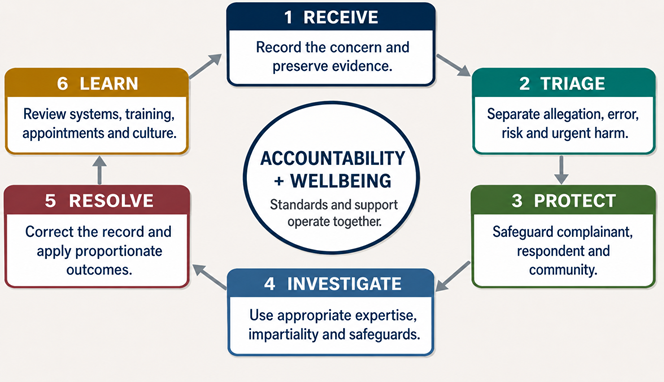
The following framework reflects an institutional response to research integrity concerns. It is a conceptual framework, inspired by the 2025 UK Concordat principles, UKRIO’s guidance, and Universities UK’s Stepchange framework for mentally healthy universities.
The Integrity-with-Humanity Framework
A proportionate institutional response to concerns about academic work
Figure 1. The Integrity-with-Humanity Framework. Author synthesis informed by UKRIO (2023, 2025a, 2025b) and Universities UK (2020). Figure rights: original author-created diagram; no third-party imagery used.
HOW TO READ THE FRAMEWORK
“Protect” precedes “investigate” because immediate safety, evidence retention, and protection from retaliation cannot wait for a conclusion. “Learn” follows “resolve” because significant cases can inform improvements to systems, including where misconduct is not established.
•
Receive concerns through a confidential, accessible route and preserve original material.
•
Triage the concern: differentiate between attribution problems, honest errors, poor practice, disputed interpretation, misconduct, and safeguarding risk.
•
Protect everybody involved but do not promise the outcome.
•
Investigate with relevant expertise, appropriate impartiality, disclosure, rights of response, documented reasons, and reasonable timeline.
•
Resolve proportionately: correct the record, provide learning experience, and apply disciplinary actions when justified by evidence and policies.
•
Learn institutionally by reviewing recruitment, supervision, training, workload, communication, and research culture.
05 Recruitment governance should be examined, not presumed
Arday’s case raises critical issues regarding recruitment governance; however, this alone is insufficient for concluding that the University of Cambridge did not conduct due diligence. On 12 August, the Vice Chancellor said an inquiry would be undertaken into the situation of Arday’s appointment in 2022 and his tenure. This inquiry will contribute to the review of the appointment process of senior scholars (University of Cambridge, 2026c).
However, the more general governance issue is a future-oriented one and not simply a finding of this case. In the field of higher education, when it comes to appointments, there needs to be proportional verification of qualifications, employment records, publications, achievements, and references, the extent of which depends on the seniority and responsibilities of the position. In cases of doubt about such an appointment, there needs to be use of the correct process for review and corrections of public information if necessary.
This approach is entirely compatible with inclusive recruitment. Verification standards should be applied consistently to all candidates, regardless of background, and should not be increased retrospectively in response to later scrutiny. Effective due diligence is evidence-based, proportionate and fair, while recognising that credibility assessments can be influenced by social networks, institutional cultures, and unconscious bias.
INCLUSION AND VERIFICATION
Inclusion and verification can both work together at once. Inclusive recruitment broadens the pool of talent, while consistent verification helps ensure that all candidates are assessed against the same standards.
06 Teach integrity as a developmental practice
Cambridge University’s 2023 profile of Jason Arday described his reflections on developing academic writing skills without consistent early mentorship and on learning through repeated rejection and feedback (University of Cambridge Faculty of Education, 2023). Whatever conclusions may be reached about disputed texts, those reflections highlight a broader lesson for higher education: universities cannot assume that the skills underpinning academic integrity are acquired automatically. Referencing, paraphrasing, source management, and scholarly writing are learned practices that require guidance and continued development throughout an academic career.
For that reason, integrity education should be viewed not only as a compliance requirement or a response to misconduct concerns, but as an ongoing element of academic development. Doctoral candidates, supervisors, early-career researchers, and senior academics can all benefit from regular training in quotation, paraphrasing, co-authorship, note-taking, version control, citation software, data management, corrections, and the responsible use of generative AI. Such training is often most effective when it is grounded in discipline-specific examples rather than generic definitions of plagiarism.
Supervision and mentoring also play a vital role. Researchers may understand the principle of avoiding plagiarism yet still struggle to distinguish effective synthesis from overly close paraphrasing, particularly when working under linguistic, cognitive, or time pressures. Formative feedback, writing support, and good record-keeping practices provide opportunities to strengthen these skills before problems become embedded in the scholarly record. Viewed in this way, integrity is not simply a matter of rule compliance; it is a professional competency that develops through education, practice, reflection, and support.
07 Communicate facts with precision and respect
Institutional public statements should clarify which process has started, which body is responsible, procedural limitation of the available information, and when the next update can be expected. Character assessments, selective disclosure, and language that predetermines the status of a respondent, complainant, or outcome are inappropriate and should be avoided.
Media literacy is also important. One needs to understand whether the claim in question is an allegation, correction, formal finding, or commentary; whether the respondent received a fair opportunity to respond; whether the passages in the academic work are shown in context; and whether the source makes a difference between textual similarity and misconduct. This will allow for more accurate scrutiny by maintaining visibility of the evidence and proper process.
Public discussion of Arday’s case has intersected with wider debates about equality, diversity and inclusion, race, and institutional credibility. However, an individual case cannot be used to validate or invalidate broader policy agendas. Issues of discrimination, academic standards, governance, and inclusion should be assessed on their own evidential merits. Maintaining these distinctions helps avoid assumptions and supports more balanced analysis.
FROM LESSON TO ACTION
A six-part compact for higher education
TABLE 2 | INSTITUTIONAL ACTION PLAN
Principle
Concrete institutional action
Evidence of success
1. Verify
Conduct proportionate due diligence regarding qualifications, publications, employment, and material public claims prior to appointment or promotion.
Documentation of checks; discrepancies addressed before public announcement.
2. Investigate
Conduct according to the published procedure, using relevant expertise, providing appropriate impartiality and conflict safeguards, disclosure, right of response, and reasons.
Timely, reviewable decisions differentiating allegations, findings, and corrections.
3. Support
Facilitate separate welfare contacts and safety procedures for complainants, respondents, witnesses, and affected teams.
Awareness of where to seek help; management of identified risks and workload pressures.
4. Communicate
Provide accurate information about the status and correct any misinformation about the institution if necessary.
Messaging is accurate, proportionate, and in line with the procedural status.
5. Repair
Correct relevant publications, repositories, and web pages; make outcomes proportional to severity, intent, pattern, and impact.
Research record is factual, and outcome is clearly proportional.
6. Learn
Use significant cases to review recruitment, supervision, training, governance, and culture.
Actions, owners, and deadlines are reported to relevant governance bodies.
Author synthesis based on UKRIO research-integrity guidance and the principles discussed in this article.
CONCLUSION
Accountability, due process, and institutional learning
The central governance lesson is that research integrity is strongest when academic standards, fair procedure, proportionate support, and organisational learning operate together.
The circumstances surrounding the Jason Arday case raise important questions for higher education, but they do not provide simple answers. Allegations, investigations, findings, questions of governance, and issues of wellbeing each require careful and distinct consideration. The challenge for institutions is not to choose between accountability and compassion, but to demonstrate both. Research integrity is strengthened when standards are rigorous, processes are fair, communication is measured, and support is available to those affected. The most resilient institutions are those that can pursue the truth, uphold due process, and learn from difficult cases without losing sight of the people involved.
Fuad Trayek’s work has earned distinguished international recognition, marking a pivotal year for LSST Wembley. Photo: LSST.
Dr Fuad Trayek, aprominent academic at LSST Wembley, has achieved significant international recognition following a landmark year of published research spanning educational leadership, digital citizenship and cultural diplomacy.
Dr Trayek has also been appointed to the Editorial Board for the Journal of Educational Sciences (Al-Asmarya Islamic University, Libya). This prestigious editorial appointment accompanies a formal Certificate of Appreciation awarded to Dr Trayek for his peer-review contributions to the Journal of Interdisciplinary Studies in Education.
These academic appointments cap an exceptionally productive year at LSST during which Dr Trayek published three major peer-reviewed papers advancing critical debates in modern higher education:
Dr Trayek’s research momentum continues with two upcoming papers entering final review for elite and internationally recognised journals. His published work has achieved significant global reach – accumulating over 245 citations from fellow academics worldwide and demonstrating a consistent track record of high-impact scholarship across multiple studies.
Mr Ali Jafar Zaidi, CEO of LSST, said:
“Dr Trayek’s editorial appointment and outstanding research record represent a significant milestone for LSST Wembley. His research exemplifies the academic rigour driving our campuses and demonstrates how our educators actively contribute to global academic discourse.”
Professor Paul McDermott, Principal of LSST, added
“Having our teaching staff directly involved in peer-reviewed scholarship and international journal boards ensures our academic portfolio remains strong. This active research culture directly enriches the educational experience for our students and supports our approach of research informed delivery.”
Mohammad Haider, Academic Dean at LSST Wembley, said:
“We are extremely proud of Dr Trayek’s achievements. His international appointments and published papers underscore the growing research momentum at LSST Wembley that bridges critical insights in leadership and digital ethics directly with our campus community.”
Dr Fuad Trayek, said:
“Engaging with international journals and presenting research on global platforms like IDSS in Valencia provides a vital exchange of ideas. I look forward to contributing these insights to LSST’s research profile and collaborating on future institutional research initiatives.”
Dr Maryam Idris-Usman, LSST Research Centre Coordinator, added:
“Dr Fuad’s scholarly contributions highlight the vital connection between academic research and institutional growth. His work on digital citizenship and educational leadership offers valuable frameworks for navigating complex modern learning environments.”
We hope you enjoyed reading LSST News. Join our vibrant academic community and explore endless opportunities for growth and learning at www.lsst.ac/coursesor via admissions@lsst.ac. Discover your path at LSST and embark on a transformative educational journey today.
Think Further. Think Higher. Think LSST.
For additional information or interviews, please direct questions to LSST’s Public Relations Manager viakunal.mehta@lsst.ac.
(l-r) Timothy Mettis (Hounslow Council), Kimberley McGinty (McAleer and Rushe) and Steve Farrow (MIT Skills) at LSST’s Construction and Community Impact Luncheon. Photo: LSST
Against the backdrop of a growing UK construction labour deficit, LSST Wembley brought together leading Tier 1 and 2 contractors, local authority leaders and community investment teams for its
Construction and Community Impact Luncheon.
Recent sector data from the Construction Industry Training Board
(CITB, 2026) projects that the UK construction sector must recruit over 41,200 additional workers each year through 2030 – totalling over 206,000 new entrants – to meet growing output demands and offset structural retirements.
To address this challenge within Greater London, LSST hosted major
contractors – including Mace Group, McAleer & Rushe, Morgan Sindall and Wates, McGee and Quinn London – alongside local representatives to align vocational and construction skills training
with industry requirements.
Learners Take Centre Stage
During an interactive Q&A session hosted by Ezekiel Afolabi, LSST’s Employer Engagement Manager, learners shared their personal
journeys, practical training experiences and career ambitions directly with key decision-makers.
After the main presentation, delegates visited LSST Wembley’s
state-of-the-art Construction Training Centre, viewing the purpose built facility where local learners develop site-ready
skills and achieve their CSCS Cards.
The event featured contributions during an open-floor discussion, with insights provided by Chris King, Social Value Manager at Morgan Sindall Infrastructure, Timothy Mettis, Employment Engagement Coordinator at Hounslow Council, and Mark Anfilogoff, Founder of Surviving the Gap.
Mr Ali Jafar Zaidi, CEO of LSST, said:
“Our role across the further and higher education sector extends far
beyond traditional delivery; we are an engine for social mobility and
local economic growth. The commitments shared today demonstrate that
when providers, civic leaders and industry heavyweights collaborate with
clear intent, we construct a resilient site-ready workforce equipped to
power London’s future.”
Matt Garvey, Head of Further Education and Business
Development at LSST, said:
“Employers play a vital role in making any skills programme succeed and
in opening up job opportunities for our learners. Events like this give
employers a chance to share the skills and qualities they value, helping
us align our training accordingly. They also give learners valuable
insight into what’s expected of them in the construction industry.”
“The strong turnout from major contractors and local authorities,
combined with our learners confidently sharing their journeys, perfectly
demonstrated the impact of our training. The energy in the room was
highly positive, and it was fantastic to secure tangible commitments
from employers to back our future provisions and provide ongoing
opportunities for our learners.”
Faye Meleti, FE Programme Manager at LSST, added:
“It was wonderful to see our learners engaging so confidently today and
proudly presenting their achievements. Seeing how much their confidence has grown since joining the programme was truly inspiring. It was especially encouraging to see them engaging with employers, showcasing their skills and taking positive steps towards their future careers.”
(l-r) Discussing all things construction: Louis Garner (Wates Property Services), Pedro Ribeiro (Quinn London), Chris King (Morgan Sindall). Photo: LSST(l-r) Strengthening sector links and exploring new opportunities: Mark Anfilogoff (Surviving the Gap), Stephen Surridge (DWP), Davina Mintah (Mace), Cory Ricketts (Mace). Photo: LSST.Ezekiel Afolabi (LSST’s Employer Engagement Manager) and Mark Anfilogoff (Surviving the Gap). Photo: LSST.(l-r) Bringing industry leaders together inside LSST’s Construction Training Centre: Mona Marcu (Crystal & Co), Pedro Ribeiro (Quinn London), James Newman (McGee) and Cory Ricketts (Mace). Photo: LSST.(l-r) Ezekiel Afolabi (LSST’s Employer Engagement Manager) with Bilol Rahmonov (LSST Bootcamp Graduate). Photo: LSST.
Demonstrating the event’s immediate impact, attending employers committed to backing future LSST cohorts through direct site opportunities, hands-on training support, and clear routes into long-term employment.
LSST launches new construction training programmes from September 2026 and this forum ensures that the training is aligned to what local employers really need. For more information on LSST’s construction training offer visit www.lsst.ac/fe.
Reference
Construction Industry Training Board (CITB) (2026). Construction Workforce Outlook 2026–2030. Bircham Newton: CITB. Available at:
https://www.citb.co.uk/cwo
For additional information or interviews, please direct questions to LSST’s Public Relations Manager viakunal.mehta@lsst.ac .
We hope you enjoyed reading LSST News. Join our vibrant academic
community and explore endless opportunities for growth and learning at www.lsst.ac/coursesor via admissions@lsst.ac. Discover your path at LSST and embark on a transformative
educational journey today.
Beyond the headlines of crisis, British higher education is quietly sparking a new era of innovation. Image illustration: By the author using Adobe Firefly and Gemini.
Read the headlines, and you could be forgiven for believing British higher education is finished. Campus reserves are draining, AI is destabilising familiar teaching and a hostile political class is questioning the value of degrees. The panic is understandable and the crisis real, yet the popular diagnosis gets it wrong. While the next few years will be painful, they may prove to be the catalyst that forces an overdue structural evolution.
The mass-market model of British higher education that took shape through the reforms of the early 1990s is now running out of road (UK Parliament, 1991). The standard three-year degree remains one of the most powerful forms of education. But it can no longer be expected do everything, for everyone, in the same way. Careers are changing. Technology is changing. The population is changing. Employers' expectations are changing. So, in turn, higher education must change too.
Nick Hillman, Chief Executive of the Higher Education Policy Institute (HEPI), says the British higher education sector is still resilient and thriving. Photo: HEPI/used with permission.
Nick Hillman, Chief Executive of the Higher Education Policy Institute (HEPI), told LSST Life:
"[Higher Education] is definitely not dying; in many ways, the sector is thriving. On A-Level results day [2026] alone, a quarter of a million school leavers secured places. While individual institutions face severe financial pressure...the sector remains resilient. There’s a lot of negative media perception, but it’s not all rooted in evidence."
He added: "Doom-laden narratives underestimate the high aspirations of people, who recognise that fulfilling careers increasingly require higher education qualifications."
Recent UCAS figures make that difficult to dismiss. A record 262,820 UK 18-year-olds secured higher education places in 2026, while the national entry rate remained firm at 31.6%.
Kim Eccleston, Head of Universities and Colleges at UCAS, told LSST Life:
"A record number of UK 18-year-olds are celebrating after gaining a place at higher education institutes and colleges this year, showing that school leavers continue to see higher education as a worthwhile investment in their futures and the best route to unlock their career ambitions."
The economic case has not disappeared either. At age 37, median earnings among women who attended university are 56% higher than among women who did not, with the equivalent gap for men standing at 28% (Department for Education, 2026). Government projections show that these differences persist throughout working lives - after accounting for tax, National Insurance and student loan repayments – the average graduate can expect to be around £100,000 better off than a person with same starting background and academic potential who did not graduate (Department for Education, 2026).
Of course, not every degree, institution, or teaching style is equally guaranteed to succeed. But the evidence itself clearly rejects the idea that higher education has lost its value. What has changed is the flawed assumption that institutions can stand still while the world around them accelerates.
The good news is that the policy architecture to enable a much needed shift is now here. The incoming Lifelong Learning Entitlement (LLE) begins to move student finance away from the assumption that higher education must be consumed as one continuous block. From January 2027, eligible learners will be able to use funding for approved modules as well as full courses, creating the beginnings of a more modular model in which people can return and retrain as their circumstances change.
Patrick Milnes, Head of People and Work Policy at the British Chambers of Commerce, told LSST Life:
"Higher education institutes play a vital role in the UK economy, producing skilled graduates, driving innovation, strengthening the country’s cultural offering and boosting growth. While many have improved links with employers through placements, apprenticeships and industry partnerships, businesses still see opportunities for closer alignment with the needs of our fast-changing labour market."
However, Philippa Pickford, Director of Regulation at the OfS, warns: "While the sector has reported a modest improvement in financial performance, significant challenges remain."
OfS data show that 35.8% of English higher education providers reported a deficit in 2024–25, a figure forecast to rise to 42.7% for the 2025–26 data set (OfS, 2026a). This pressure is reshaping today’s decisions about courses, staffing, recruitment and, ultimately, what individual higher education institutions stand for. Some will adapt successfully. Others may have to shrink, merge or close. But that alone is not necessarily evidence of a sector in terminal decline. It may instead be the uncomfortable process by which an even better system takes shape.
In the age of AI
A new Policy Exchange report (17 August 2026) found that 78% of UK universities use online exams for summative assessment, while 70% plan to continue doing so. Only 10% use online invigilation for all their remote exams, while 67% of university policies for such exams do not mention generative AI (Newton, 2026). The implications go well beyond assessments and into industry. According to the Institute of Student Employers (2026), nearly nine in ten (87%) of employers expect AI adoption to reshape graduate and apprentice roles.
Stephen Isherwood, joint CEO, Institute of Student Employers, told LSST Life:
"AI is yet to replace entry-level jobs at scale, instead we're seeing roles reshaped. That means graduates getting to grips with using AI for routine tasks such as admin, first content drafts and work with basic data. This requires a good level of critical thinking and judgement. Employers are looking for people who can adapt to different working practices and collaborate with others. We're seeing more call for general digital literacy and AI skills too."
This reality renders the simplistic 'AI v Graduates' debate obsolete. Far from diminishing the value of higher education or rigorous assessment, automation actually raises the stakes for the respective human skills a degree is meant to build.
Innovation in action
The most encouraging response is not coming from grand predictions about the future. It is visible in what institutions are already doing. In the table below, you see it in Staffordshire University building a virtual campus inside the Fortnite game to meet students on their own terrain and Queen's University Belfast launching alcohol-free e-sports hubs, offering a different way of thinking about campus social life.
At UWE Bristol, lectures are being swapped for high-pressure major disaster simulations, while Imperial College London is turning student ideas into commercial scaleups through an entrepreneurship ecosystem.
UK Higher Education: Models of Excellence (2025/2026)
Analysis of Strategic Institutional Innovations Across UK Higher Education
Rank
University
Innovation / Model
What They Did
Why it's Innovative
Award / Recognition
Lesson Learned for UK HE
Source
1
University of Staffordshire
StaffsVerse: university campus recreated as a Fortnite island
Virtual recreations of three campuses, mini-games and interactive experiences; built by students through the 1UP in-house games studio placement programme.
Turns university recruitment/orientation into an interactive gaming experience and gives students real production experience.
Gold - Heist Awards 2025 / Innovative Use of Technology
Make the university part of the culture students already inhabit and let students build the experience.
Integrated support taking student and academic ideas from concept towards startups, scaleups and global markets; global hubs and Venture Treks expand access.
Makes the university a venture-building platform rather than simply a place to obtain a qualification.
Winner - Times Higher Education Awards 2025, Outstanding Entrepreneurial University
Make entrepreneurship a core university experience and connect ideas to capital, markets and mentors.
Students and staff co-create a large programme of activities around belonging, learning, wellbeing and engagement; more than 200 activities and about 20,000 participants since 2022.
Moves the student experience from a service delivered to students towards a community built with students.
Advance HE Collaborative Award for Teaching Excellence 2025; Royal Society of Chemistry Inclusion & Diversity Prize 2025
Gives students genuine ownership and co-creation roles/power.
Students work directly with staff/developers to iteratively improve the university app covering timetables, results, digital ID, library entry, navigation and support.
Students become product developers and co-creators of the institution's digital experience.
Winner of UCISA Transformation Award 2025
Build university services with students, not merely for them.
Staff and community members submit ideas, investigate them, prioritise solutions, implement changes and check results/examples include meeting-free Fridays and improved induction.
Turns institutional innovation into repeatable participatory process rather than isolated projects.
Institutional innovation programme; Strathclyde also won five Scottish Knowledge Exchange Awards in 2025 across related work.
Creates a mechanism through which everyone in the university can improve the institution.
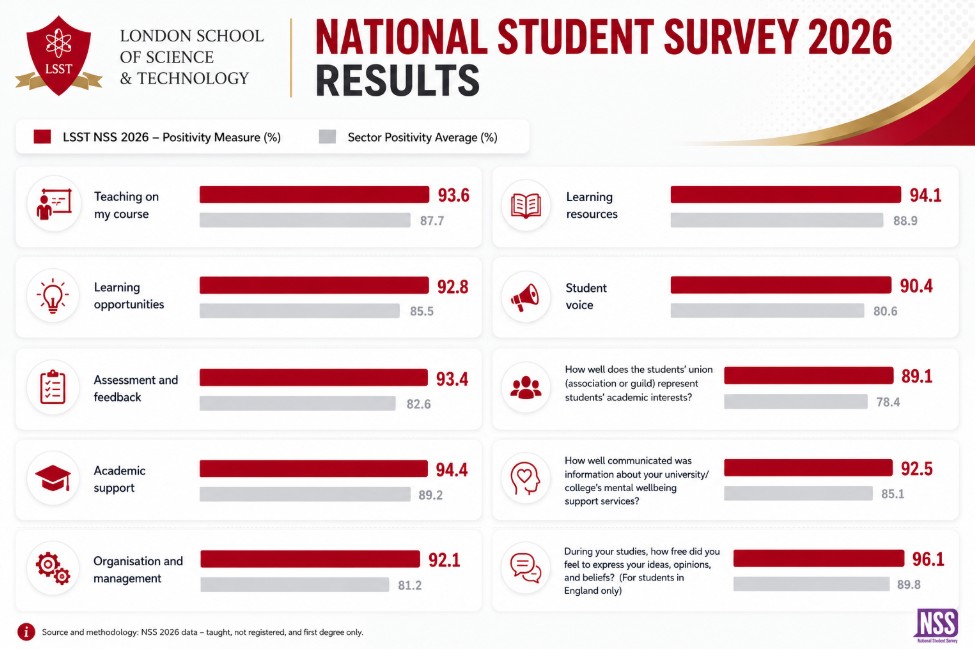
Across the sector, the institutions proving most resilient are the ones ditching passive, one-size-fits-all teaching in favour of hands-on experience in the real-world. Much of this approach is already delivering results at LSST. In the 2026 National Student Survey (NSS), LSST achieved over 90% positivity across nine core themes. That is one institution's result and not proof of a one-size-fits-all formula – but it does point towards something important. Students respond to education that connects what they learn with what they are being prepared to do.
Across the sector, forward-looking institutions are beginning to abandon outdated delivery models to rebuild what higher education offers. This shift is not limited to traditional degree pathways. It is rapidly reshaping further education and adult skills provision. Through Skills Bootcamps and accredited technical training, providers are demonstrating how employment-led education can bridge regional skills gaps. By connecting adult learning and technical retraining more closely with higher education, institutions are creating the flexible modular learning people need to keep up with a changing labour market.
What is higher education actually for?
If the answer were just to "train workers", a trade school would do. If it were only to "generate research", a lab would suffice. Higher education exists for something bigger: to build critical minds, develop expertise, build knowledge; and solve global problems. It is not a factory for degrees but a proving ground - a place where people learn to think.
Negative headlines will continue to trumpet a system in decline but they confuse structural upheaval with structural demise. Research-intensive universities, specialist institutions, further education colleges, employer-led apprenticeships and private further and higher education providers such as LSST can serve different purposes without any of them being inherently less valuable. That is not a collapse. That is evolution.
The author thanks the Higher Education Policy Institute (HEPI), the Office for Students (OfS), Universities UK (UUK), the Universities and Colleges Admissions Service (UCAS), the British Chambers of Commerce (BCC) and the Institute of Student Employers (ISE) for their time and support with this article.
Declaration: ChatGPT was used to review grammar and clarity in a final draft and several small changes were subsequently made. The title image was created using Adobe Firefly and Gemini software by the author using prompts for degree hat and Union Jack. Views are the author's or contributors' own.
House of Commons Education Committee (2026). Higher Education and Funding: Threat of Insolvency and International Students. Ninth Report of Session 2024–26. HC 807. London: House of Commons. Available at: Higher Education and Funding: Threat of Insolvency and International Students (accessed 18 August 2026).
Celebrating success: LSST learners and colleagues mark a year of growth and national recognition for LSST’s Further Education provision. Photo: LSST.
The 2025-26 academic year marked a transformative chapter for LSST Further Education. Over the past twelve months, FE provision grew from £60,000 to £670,000, supported more than 200 learners and expanded across London, the Midlands and West Sussex.
To drive workforce development, LSST built key relationships with major industry employers, including McConnell Group, Clarion Housing, Sovereign Network Group, Morgan Sindall Infrastructure, ROB Construction, and Endeavour Homes.
2025–26 Key FE Highlights at LSST:
Top Ofsted Inspection Grade: Awarded top grades for Quality of Teaching and Leadership & Management across FE provision.
100% Completion & Interview Rates: Delivered a 100% completion rate and guaranteed job interview placements for learners on GLA-funded Adult Skills Bootcamps.
£1M Facilities Investment: Opened a state-of-the-art Construction Training Centre in Wembley to support London’s skills pipeline.
Outstanding Progression: Achieved a 78% positive progression rate into employment, education, or training via the Youth Trailblazer programme.
Entrepreneurial Success: Supported over 60% of Painting & Decorating Skills Bootcamp graduates to establish themselves as self-employed tradespeople.
Quality Assurance: Earned matrix Standard accreditation in recognition of high-quality Information, Advice and Guidance (IAG) services.
Leadership Excellence: Supported over 250 learners through the ILM Assured LSST Leadership & Management Programme.
Geographical Expansion: Launched new Construction Skills Bootcamps in West Sussex, broadening regional employer networks.
Mr Ali Jafar Zaidi, LSST’s CEO, outside the LSST’s Wembley Construction Training Centre, established to tackle regional skill shortages and expand adult training pathways. Photo: LSST.
From top Ofsted inspection grades to a new £1m Construction Training Centre, Head of FE Matt Garvey reflects on a transformative 2025–26 academic year. Photo: LSST.
Leading this journey has been Head of Further Education, Matt Garvey, whose strategic vision has helped shape one of the most successful years in LSST’s FE development. Reflecting on the past twelve months, Matt emphasised that these successes have been driven by a shared commitment to widening opportunity and delivering high-quality skills provision.
“There was a genuine appetite to do more,” said Mr Ali Jafar Zaidi, CEO of LSST. “Matt and I shared a clear vision of expanding LSST’s Further Education provision and creating transformative opportunities for learners. The progress we’ve made over the past year reflects the talent and ambition of colleagues across the organisation. Their commitment has helped deliver more than £670,000 in growth, allowing us to extend our reach, respond to employer needs and make an even greater impact on the communities we serve.”
Meeting Regional Demand & Tackling NEET Rates
One of the year’s early milestones came in September 2025 when LSST celebrated its first 100 Skills Bootcamp achievements in London. Building on that momentum, LSST expanded into construction training – addressing critical skill shortages and major regeneration projects across Wembley and London. Following the rollout of its Painting & Decorating Skills Bootcamp, LSST invested in its purpose-built Wembley Construction Training Centre on Wembley High Road (London).
“Construction has always been central to our long-term strategy,” Matt Garvey explained. “We recognised the immense demand for skilled trades and created practical learning routes leading directly to employment, apprenticeships and self-employment.”
LSST Bootcampers and colleagues celebrate a year of achievement, with Head of Further Education Matt Garvey receiving the Distinguished Provider of Adult Skills Award at the Mayor of London Awards (lower right). Photo: LSST.
In parallel, LSST strengthened its footprint in the Midlands through the Government’s Youth Trailblazer pilot programme in Birmingham, designed to support young people who are Not in Education, Employment, or Training (NEET). Mobilised within weeks of contract award, the initiative was led by key figures including Dr Wendy Wigley (Head of Student Lifecycle & Partnerships Manager), Foteini Meleti (Programme Manager), and Danny Hurst (Employability Tutor), building a high-performing local team that delivered a standout 78% positive progression rate.
LSST Wins The Mayor of London’s ‘Distinguished Provider of Adult Education Award’ in 2025. (l-r) Mr Ali Jafar Zaidi, CEO, Dr Wendy Wigley, Head of Student Lifecycle & Partnerships Manager, Charlie Tennant, Vice Principal, Danny Hurst, Employability Tutor, Foteini Meleti, Bootcamp Programme Manager, Matt Garvey, Head of Further Education and Business Development, and Laila Moussaid, Executive Assistant and Project Manager. Photo: LSST.
A Vision for the Future
Despite the rapid scale-up, Matt emphasises that internal collaboration remains the cornerstone of LSST’s success.
“This has been a genuine team effort,” Matt noted. “I’d particularly like to thank Foteini Meleti, our Programme Manager in London, and Samina Shafieq, Youth Trailblazer Programme Manager in Birmingham. Their dedication to learners and commitment to excellence underpinned every benchmark we hit this year.”
Looking ahead, LSST’s expansion trajectory shows no signs of slowing. LSST has secured £1 million through London Talent Pathways to deliver construction qualifications out of Wembley over the next two years, with further delivery continuing across West Sussex and new employer partnerships on the horizon.
As LSST prepares for its next full Ofsted inspection, Matt remains focused on sustainable quality:
“Over the past year, we’ve proven that rapid scale can go hand-in-hand with top-tier educational quality. As we look to the future, our focus remains firmly on creating outstanding opportunities for learners, serving our employer partners, and positioning LSST as one of the country’s leading Further Education providers.”
For additional information or interviews, please direct questions to LSST’s Public Relations Manager via kunal.mehta@lsst.ac.
We hope you enjoyed reading LSST News. Join our vibrant academic community and explore endless opportunities for growth and learning at www.lsst.ac/courses or via admissions@lsst.ac. Discover your path at LSST and embark on a transformative educational journey today.
LSST Birmingham learners joined Jamma Wellbeing for a Brain Smart® Mental Health Ambassador programme exploring how the brain influences behaviour, emotions and wellbeing. The learners are now equipped to champion mental health within their communities. Photo: LSST
Forty learners at LSST Birmingham have taken an important step towards becoming champions for mental wellbeing after completing an innovative Brain Smart® Educational Programme for Communities, delivered in partnership with Jamma Wellbeing. They are all now ready to train as Community Mental Health Ambassadors.
Sajda Butt, Lead Trainer at Jamma Wellbeing, introduces learners to Brain Smart®, the organisation’s evidence-informed educational framework that explains neuroscience in simple and accessible language. Photo: LSST.
Bringing together undergraduate students from LSST’s Health & Social Care and Business programmes, the interactive sessions equipped learners with practical knowledge of neuroscience – focusing on how the brain influences emotions and behaviour – while actively reducing mental health stigma.
Rather than viewing mental ill-health as a personal failing, Brain Smart® – Jamma Wellbeing’s evidence-informed educational framework – helps individuals understand why the brain responds as it does during periods of stress and emotional challenge.
Richard Stewart, Director of Jamma Wellbeing, joined the opening session to introduce the organisation’s mission and engage directly with learners, laying the foundations for what both organisations hope will become a long-term collaboration benefiting LSST students and communities across Birmingham.
Beyond enhancing mental health awareness, the programme also enabled learners to strengthen key professional competencies sought by top employers. Photo: LSST.
The programme also focused heavily on professional development. Students cultivated critical transferable skills – such as active listening, leadership, and community engagement – that directly strengthen CVs, personal statements and job interviews across health, education, business, and public sectors.
The programme concluded with the inaugural meeting of LSST Birmingham’s Men’s Working Group, bringing together staff and learners to lay the foundations for a long-term initiative dedicated to advancing male mental health and wellbeing.
Mr Mohsin Riaz, Dean at LSST Birmingham, said: “Supporting mental wellbeing is fundamental to student success and employability. This programme demonstrates LSST’s commitment to creating an environment where learners not only achieve academic excellence but also develop the confidence and skills needed to thrive in their careers. We are delighted to begin this partnership with Jamma Wellbeing and look forward to expanding its impact across Birmingham.”
Samina Shafieq, Careers and Employability (HE) and Programme Manager (FE) at LSST Birmingham, who led the initiative, said:
“What has been truly inspiring is seeing our learners move beyond understanding mental health to recognising their own ability to support and encourage others. This programme has created a space for honest conversations, while helping students develop core skills that will benefit them throughout their careers and lives. We are delighted to work with Jamma Wellbeing and look forward to creating lasting impact across our student community and beyond.”
The Mental Health Ambassador initiative reflects LSST’s commitment to helping students thrive both personally and professionally. Through its partnership with Jamma Wellbeing, LSST is giving learners the knowledge, confidence and skills to better understand mental health and make a positive difference in their workplaces and communities.
For additional information or interviews, please direct questions to LSST’s Public Relations Manager via kunal.mehta@lsst.ac.
We hope you enjoyed reading LSST News. Join our vibrant academic community and explore endless opportunities for growth and learning at www.lsst.ac/courses or via admissions@lsst.ac. Discover your path at LSST and embark on a transformative educational journey today.
Liliana Gabriela Andronie, BA (Hons) Business Management graduate and Student Support Officer at LSST Luton, reflects on her transformative journey. Photo: LSST.
By Liliana Gabriela Andronie, Student Support Officer, LSST Luton
When I enrolled on the BA (Hons) Business Management programme at LSST Luton in 2021, I was juggling family responsibilities, work commitments and the uncertainty of being the first person in my family to pursue higher education. Completing this degree was never just an academic goal – it was a deliberate step toward reshaping my future, building confidence and unlocking opportunities I had once thought out of reach.
As the first member of my family to pursue higher education, completing my Business Management degree became both a personal milestone and a commitment to creating new opportunities through education and learning.
What stood out about LSST was the personalised support and sense of community throughout my journey. As a student balancing different responsibilities, having approachable lecturers and a supportive learning environment made a real difference. LSST helped me build the confidence, knowledge and practical skills to achieve my academic goals and take the next step in my professional development.
Academic Growth and Leadership
The Business Management degree strengthened my capabilities in both critical thinking and professional confidence.
Throughout my studies, I developed a strong understanding of leadership, teamwork and effective communication. Exploring a range of leadership and management theories, alongside practical case studies, strengthened my ability to evaluate different approaches and apply them in real-world situations.
My learning also enhanced my strategic thinking and problem-solving skills, encouraging me to think creatively and adapt to changing circumstances. I gained an appreciation of how organisations foster innovation and respond to new challenges, developing a solution-focused mindset that I continue to apply in my professional life.
In addition, I deepened my understanding of organisational change and development. Studying how organisations evolve and how leaders manage periods of transition helped me to analyse complex challenges, appreciate different perspectives and understand the importance of effective planning and communication when implementing change.
During my foundation year, my lecturers fostered a sense of community in our classes. One memorable moment was a special lunch where every student brought a meal to share. Sitting together, we laughed, exchanged stories and supported each other’s learning. Small moments like these made the academic journey feel inclusive and motivating.
Another inspiring moment came in Year 2, when our lecturer Sayed Baheer Peerzada delivered a speech about the power within each of us. He emphasised that we could achieve anything we set our minds to, regardless of challenges like language barriers. His words resonated deeply, reminding me to embrace my potential and pursue my goals with confidence. This encouragement fueled my determination to engage fully in class discussions, presentations and projects.
Assignments reinforced these lessons. One particularly valuable project involved analysing a real-world organisation undergoing large change. I evaluated leadership strategies, identified barriers to success and proposed practical recommendations. This experience honed my analytical skills and strengthened my confidence in applying theory to practice.
Taking part in LSST’s Writing Competition was a particularly rewarding experience that challenged me to communicate complex ideas in a clear, engaging and accessible way. The competition encouraged me to strengthen my research, critical thinking and academic writing skills while considering how to present my ideas to a wider audience. Seeing the competition judged by professionals from organisations such as CNN International and The Tony Blair Institute for Global Change highlighted the importance of effective communication beyond the classroom. It reinforced my confidence as a writer and demonstrated how strong written communication can influence, inform and inspire others.
Skills Gained Throughout My Degree
My Business Management degree equipped me with far more than academic knowledge. Across my modules, I developed a combination of analytical, professional and interpersonal skills that continue to shape the way I approach both my work and personal development.
Modules such as Research Methods, Business Consulting, Project Management, Strategic Marketing and Data Insights for Business Decisions challenged me to think critically, analyse complex situations and make evidence-based decisions. Rather than simply learning business theories, I gained an understanding of how they can be applied to real organisational challenges, from managing change and leading teams to developing innovative solutions and making informed strategic decisions.
The programme also strengthened the skills that employers value most. Through presentations, group projects and collaborative learning, I became a more confident communicator and developed the ability to work effectively with people from a wide range of backgrounds.
Delivering 11 presentations and contributing to more than five major group projects improved my confidence in presenting ideas, listening to different perspectives and working towards shared goals. Perhaps most importantly, the degree taught me how to manage competing priorities, remain organised under pressure and adapt to new challenges. These are skills I now use every day in my professional role, giving me the confidence to contribute meaningfully to my team while continuing to grow as a business professional.
Completing my degree while raising a family and maintaining employment was one of the most demanding experiences of my life. There were times when balancing assignments, work commitments and family responsibilities felt overwhelming, but each challenge strengthened my determination to keep moving forward.
Studying at LSST taught me to manage my time more effectively, prioritise competing demands and remain focused even during the busiest periods. Looking back, I realise that the resilience, organisation and self-discipline I developed were just as valuable as the academic knowledge I gained. Those qualities continue to influence how I approach my work today and have given me the confidence to embrace new responsibilities and opportunities.
Linking My Degree to Professional Progression
The leadership frameworks, innovation strategies and change management principles I studied now influence how I approach challenges and responsibilities within the workplace.
Today, as a Student Support Officer at LSST Luton, I use the communication, organisational and problem-solving skills developed during my degree to support learners and contribute positively to the student experience.
LSST supported not only my academic development but also the growth of my confidence as a professional. It provided structure, guidance and an environment where development, learning and progress were consistently encouraged.
My Message to Fellow Students
My journey has taught me that your starting point does not define your destination. Whether you are returning to education after a break, balancing family and work commitments, or taking your first steps into higher education, progress is possible through determination, consistency and the right support.
There will be challenges along the way, but every assignment completed, every skill developed and every obstacle overcome contributes to personal growth. A degree represents more than an academic achievement; it builds confidence, resilience and the ability to see new possibilities for the future.
My advice to fellow students is simple: believe in your own potential, embrace the learning journey and remember that every step forward brings you closer to the opportunities you once thought were beyond reach.
Completing my degree does not mark the end of my educational journey; instead, it represents the beginning of a new chapter defined by ambition, professional growth and the ability to pursue opportunities that once felt beyond reach.
I remain committed to continued academic and professional development and am deeply grateful to my LSST lecturers, whose guidance, expertise and encouragement played an important role in my journey. The knowledge, skills and resilience I developed continue to shape my career path, influence my professional goals and inspire my commitment to lifelong learning.
By Hamis Ejaz, Lecturer in Business, LSST Luton and Hararia Ijaz,
Teaching Fellow in Business, LSST Luton.
The role of technology in higher education has changed considerably over the past few years. Classrooms are no longer isolated spaces where learning happens only through lectures and static materials. Instead, they sit within a wider digital environment where students constantly access information, communicate, and develop skills that go beyond traditional academic content.
In this context, technology is no longer an optional addition to teaching. It has become part of how students learn and how they prepare for future professional environments. Digital tools already support many aspects of teaching, particularly engagement, accessibility, and interaction. While virtual learning environments remain central, there are also moments during teaching where more immediate and flexible tools can add value. These might
include quick access to resources, short interactive activities, or tools that allow students to respond and participate in real time while also allowing the students to learn with greater efficiency. If used appropriately, these approaches can make teaching more dynamic and responsive. This shift is particularly significant with the rise of AI, which is changing not only how students access information, but also how lecturers support learning and prepare students for employment.
AI, Lecturers and Graduate Readiness
The growth of AI also changes the role of lecturers in higher education. If information is now instantly available through digital platforms and AI tools, teaching cannot be limited to the delivery of content alone. The lecturer’s role increasingly involves guiding students in how to question, evaluate and apply information in meaningful ways. This positions lecturers as mentors, coaches and curators of knowledge who help students develop judgement, confidence and critical thinking (Atchley et al.,2024).AI should also be understood as part of graduate readiness. Many employers now expect graduates to work confidently with digital tools, including AI-supported systems. Therefore, higher education has a responsibility to help students use AI ethically and effectively, rather than avoiding it altogether. This includes developing skills such as prompt writing, information checking, responsible referencing, digital judgement and awareness of bias. In this sense, AI is not only a teaching tool, but also an employability capability that students need for the future workplace.
The Changing Nature of Learning in Higher Education
Students today approach learning differently from previous generations. They are used to accessing information instantly, engaging with content through digital platforms, and interacting in more fluid and flexible ways. Research suggests that when technology is used effectively, it can enhance engagement, collaboration, and overall learning outcomes (Bond et al., 2020). Because of this, teaching that includes digital elements often feels
more aligned with how students already learn. This does not mean replacing traditional methods, but rather complementing them in ways that can improve both the efficiency and effectiveness of teaching. A balanced approach allows teaching to remain structured while also being adaptable. Ignoring this shift can create a gap between students’ expectations and their actual learning experience. However, Nikolic et al., (2024) question the adaptability and application of modern technologies, stressing that proper implementation and adaptability of digital technologies are essential for improved student outcomes.
The emergence of digital technologies and mobile devices has led to the disruption of the traditional classroom environment, with focus shifting towards self-directed use of technologies. Lai et al., (2022) argue in favour of employing self-directed use of mobile devices amongst students and its perceived benefits, especially in out-of-class learning, while Wu et al., (2024) concluded that AI-assisted learning allowed an increase in student efficacy. A study from Esiyok et al., (2025), also recommended the integration of self-directed learning with technologies (SDLT) into activities and the updating of course curricula for enhanced support. Chugh et al., (2023), however, argue that implementation of such technologies requires changes at the institutional level, along with a focus on individual technologies for better integration into the learning environment, and appropriate training of the staff to handle and utilise such technologies most effectively.
Technology as a Tool for Engagement and Inclusion
One of the most noticeable benefits of technology in teaching is its ability to support engagement and inclusion. Not all students feel comfortable speaking in front of others or contributing in traditional ways. Digital tools can offer alternative ways to participate, such as responding anonymously, engaging in live polls, or contributing through online platforms. When used with a clear purpose, these tools can help create a more inclusive classroom environment. Students who might otherwise remain silent often become more involved when given different ways to contribute. Research supports this, showing that digital tools can reduce participation barriers and encourage broader engagement (Henderson, Selwyn and Aston, 2017). Technology also makes learning more accessible and creates an environment that accelerates the pace at which knowledge is absorbed. Students can revisit materials and generate quick summaries, access additional content quickly, and engage in ways that suit their own pace and preferences. This is particularly important in classrooms where students come from varied academic and cultural backgrounds. However, Chugh et al., (2023) state that implementation of technology may not be equally beneficial for all students due to technical proficiency at individual levels, which may affect adoption of new technologies, and variance in its harnessed
benefits.
Balancing Professional Boundaries and Digital Innovation
At the same time, it is important to recognise the need for professionalism in student-facing environments. Policies around the use of mobile devices are often introduced to minimise distractions and maintain focus. These are valid concerns and play an important role in maintaining appropriate classroom standards. However, it is useful to consider the difference between unstructured use of technology and its purposeful use within teaching. Technology itself is not the issue; rather, it is how it is used. When digital tools are integrated with clear intent and structure, they can support learning rather than disrupt it. For example, short interactive activities, real-time feedback, or accessing relevant information during a session can enhance teaching without undermining professionalism. Research suggests that it is the design and purpose behind technology use that determines its effectiveness (Laurillard, 2012). On the other hand, Atchley et al., (2024) argue that while such technologies are effective in augmenting the typical learning environment, some students may use technology for non-academic, self-distracting purposes. On the use of generative AI such as ChatGPT, the study further states that while the use of AI can facilitate brainstorming, collaboration, editing, and providing practice, it may also lead to the fabrication of information and scholarly sources, further suggesting changes to academic policies and the structuring of assignments.
Conclusion
Higher education continues to adapt to changes in technology and society. In this context, the role of technology in teaching needs to be considered carefully. Rather than viewing digital devices solely as a source of distraction, there is an opportunity to use them in ways that support engagement, inclusion, and employability. A balanced and structured approach allows educators to maintain professional standards while also creating more flexible and relevant learning environments. This better reflects the realities of a digitally connected world and supports students in developing the skills they need for the future. Ultimately, the question is no longer simply whether technology should be present in the classroom, but how technology and AI can be used to enhance learning, strengthen critical judgement and prepare students for a rapidly changing workplace.
References
Atchley, P., Pannell, H., Wofford, K., Hopkins, M. and Atchley, R.A., 2024. Human and AI collaboration in the higher education environment: opportunities and concerns. Cognitive research: principles and implications, 9(1), p.20.
Bond, M., Buntins, K., Bedenlier, S., Zawacki-Richter, O. and Kerres, M. (2020) ‘Mapping research in student engagement and educational technology in higher education: A systematic evidence map’, International Journal of Educational Technology in Higher Education, 17(1), pp. 1–30.
Chugh, R., Turnbull, D., Cowling, M.A., Vanderburg, R. and Vanderburg, M.A., (2023). Implementing educational technology in Higher Education Institutions: A review of technologies, stakeholder perceptions, frameworks and metrics. Education and Information Technologies, 28(12), pp.16403-16429.
Esiyok, E., Gokcearslan, S. and Kucukergin, K.G., (2025). Acceptance of educational use of AI chatbots in the context of self-directed learning with technology and ICT self-efficacy of undergraduate students. International Journal of Human–Computer Interaction, 41(1), pp.641-650.
Henderson, M., Selwyn, N. and Aston, R. (2017) ‘What works and why? Student perceptions of useful digital technology in university teaching and learning’, Studies in Higher Education, 42(8), pp. 1567–1579.
Lai, Y., Saab, N. and Admiraal, W., (2022). University students’ use of
mobile technology in self-directed language learning: Using the integrative model of behavior prediction. Computers & Education, 179, p.104413.
Laurillard, D. (2012) Teaching as a design science: Building pedagogical patterns for learning and technology. London: Routledge.
Nikolic, M., Paunovic, L. and Gojgic, N., (2024). Educational
Technology–Benefits and Drawbacks in Enhancing Knowledge Acquisition Efficiency. In 10th International Scientific Conference Technics, Informatics and Education-TIE 2024. Faculty of Technical Sciences Čačak, University of Kragujevac.
Residents, students and job seekers gathered at LSST’s Birmingham Campus for a successful Community Recruitment Event, hosted in partnership with Birmingham and Solihull Mental Health NHS Foundation Trust (BSMHFT). The event connected individuals with exciting careers in mental health and community support services.
The event brought together NHS recruitment teams and members of the local community to explore a range of opportunities, including in-demand Support Time Recovery Worker and Peer Support Worker roles. Attendees had the opportunity to learn more about the positions available, gain insights into the application process and discover how their skills and lived experiences could contribute to improving the wellbeing of others.
Mr Ali Jafar Zaidi, LSST’s CEO, said: “This excellent event reflected the shared commitment of LSST and BSMHFT to widening access to employment opportunities, advancing social mobility, and strengthening community engagement across Birmingham. By working collaboratively, we are helping to create meaningful pathways into rewarding careers while supporting the long-term development and prosperity of our local communities.”
Samina Shafieq, Careers and Employability HE and Programme Manager FE at LSST, who coordinated the event, said:
“We were all delighted to welcome BSMHFT to LSST Birmingham and to see such strong engagement from members of the local community. The event demonstrated the power of collaboration between education and healthcare organisations to propel career options for our students.”
She added:
“Many attendees were encouraged to discover that compassion, resilience and lived experience are highly valued within these roles. It was inspiring to see individuals exploring opportunities to make a positive difference in the lives of others while also developing fulfilling careers for themselves.”
Mr Mohsin Riaz, Dean at LSST Birmingham, said:
“At LSST, we are committed to serving not only our students but also the wider communities in which we operate. Hosting events such as this reinforces our mission to create opportunities, build aspiration and support economic and social development.”
Representatives from BSMHFT engaged with attendees throughout the event, offering guidance on career opportunities, answering questions about recruitment pathways and highlighting the value of building a workforce that reflects the diversity of Birmingham’s communities.
The recruitment event forms part of LSST’s ongoing commitment to enhancing employability, supporting local partnerships and creating opportunities that enable individuals to contribute positively to society while pursuing meaningful and life-changing careers.
For additional information or interviews, please direct questions to LSST’s Public Relations Manager viakunal.mehta@lsst.ac.
We hope you enjoyed reading LSST News. Join our vibrant academic community and explore endless opportunities for growth and learning atwww.lsst.ac/courses or viaadmissions@lsst.ac. Discover your path at LSST and embark on a transformative educational journey today.
LSST’s strong NSS 2026 results reflect the dedication of its academic and professional teams and its inclusive, industry-relevant approach to teaching and learning. Image: LSST.
LSST is celebrating exceptional results in the National Student Survey (NSS) 2026, with a strong 73% student response rate (n=1121) and positivity scores above 90% across nine of the ten NSS themes. The results include record highs in assessment and student voice – with LSST performing above sector benchmarks across the vast majority of student experience measures, maintaining consistently high levels of satisfaction over successive years. These achievements reflect the continued confidence students place in the quality of LSST’s teaching, support and learning environment.
The NSS is independently administered by the Office for Students and Ipsos, providing one of the UK’s most recognised measures of final-year undergraduate student experience and satisfaction.
LSST’s outstanding positivity scores demonstrate its strong performance against national benchmarks, reflecting the dedication of LSST’s academic and professional teams and its inclusive, industry-relevant approach to teaching and learning.
Students gave particularly strong feedback on assessment and learning, with 93.4% positive responses for Assessment and Feedback, compared with a sector benchmark of 82.6%.
An outstanding 96.7% of LSST students agreed that assessments allow them to demonstrate what they have learned, making this one of LSST’s highest individual NSS question scores and highlighting confidence in the quality and relevance of assessment design.
Mr Ali Jafar Zaidi, CEO at LSST, said:
“These exceptional results reflect the dedication of our staff and the quality of education we provide at LSST. We are particularly pleased that our students continue to recognise the strength of our teaching, assessment and support.
We will continue listening to our students and investing in their experience, ensuring every learner has the opportunity to succeed.”
Professor Paul McDermott, Principal at LSST, said:
“The NSS results demonstrate the commitment of our academic community to delivering teaching that is both rigorous and relevant.
We are particularly encouraged by the strength of student confidence across teaching, assessment and support and by the progress we have made in ensuring students feel their feedback is heard and acted upon. We will build on this success by continuing to enhance every aspect of the student experience and strengthening the wider LSST community.”
Aasfieq Moosa, LSST’s Student Union President, said:
“These encouraging results reflect what many students experience every day at LSST – passionate teaching, supportive staff and a genuine commitment to listening to student voices. LSST’s Student Union looks forward to working with senior management to ensure every student has the best possible experience.”
Mr Syed Rizvi, Dean of Learning and Teaching and Academic Dean of LSST Elephant & Castle and LSST Stratford, said:
“The NSS 2026 results reflect the quality, commitment and passion of our teaching teams. We place students at the heart of everything we do and these results highlight the impact of our focus on high-quality teaching, meaningful engagement and continuous enhancement of the learning experience. We are proud of this achievement and remain committed to raising the standard of education we provide.”
Dr Wendy Wigley, Head of Student Lifecycle and Partnership Manager, said:
“These results are a testament to the resilience and dedication that define LSST’s community. I am incredibly proud of what our students and staff have achieved together. Our students have spoken and their feedback recognises the quality of teaching, support and opportunities that make LSST such a special place to learn.”
Mr Noman Nafees, Registrar and Head of Student Finance, said:
“These outstanding NSS 2026 results are particularly significant as they reflect feedback from the largest cohort of LSST students to take part in the survey. Achieving such high levels of positivity across teaching, assessment, support and student voice demonstrates the strength of our student experience. We are proud of the consistency of these results and remain committed to listening to our students and continuously enhancing their journey.”
LSST’s inclusive academic culture was also recognised, with 96.1% of students reporting that they feel free to express their ideas and opinions. This reflects LSST’s commitment to creating an environment where students are encouraged to contribute, challenge ideas and develop confidence.
Students also recognised the wider support and resources available at LSST, with 94.4% positive responses for Academic Support and 94.1% for Learning Resources, both significantly above sector benchmarks.
A further highlight is the strength of student voice, with 90.4% positive responses for the NSS Student Voice theme, compared with a sector benchmark of 80.6%.
LSST will also continue to strengthen assessment practices, enhance feedback processes and share examples of outstanding teaching and student support across the institution.
The NSS 2026 results provide further evidence of LSST’s commitment to delivering accessible and high-quality higher education that supports students to achieve their ambitions and succeed in their chosen careers.
The NSS gathers opinions from final-year undergraduate students about their academic experiences. The 2026 iteration was overseen by Ipsos on behalf of the Office for Students.
For additional information or interviews, please direct questions to LSST’s Public Relations Manager viakunal.mehta@lsst.ac.
We hope you enjoyed reading LSST News. Join our vibrant academic community and explore endless opportunities for growth and learning atwww.lsst.ac/courses or viaadmissions@lsst.ac. Discover your path at LSST and embark on a transformative educational journey today.
Professor Paul McDermott is LSST’s new Principal. Photo: LSST.
LSST has entered an ambitious new era. With the appointment of Professor Paul McDermott as its new Principal, the institution signals a profound commitment to academic excellence, social mobility and large-scale transformation. Professor McDermott’s mandate is clear: elevate LSST into one of the UK’s leading independent further and higher education institutions.
Bringing more than four decades of distinguished leadership across leading higher education institutions and corporate academic boards, Professor McDermott joins LSST at a definitive inflection point and has worked for numerous universities in the past, including Leicester, Northampton, Anglia Ruskin, the Open University and London Metropolitan, as well as with HEFCE, the QAA and OfS. More recently, Professor McDermott has worked as the Lead academic and Chief Academic Officer for several Private HE institutions, including NCUK and Study Group, as well as running his own consultancy firm since 2012. His arrival marks a strategic shift toward a future defined by life-changing education and leading academic infrastructure.
Culture Over Infrastructure
While infrastructure is vital, Professor McDermott’s initial focus has been entirely on the human element.
“It is a distinct honour to join LSST,” says Professor McDermott. “Across every campus, there is a rare, palpable commitment to the student experience and their outcomes. You can engineer systems and build facilities, but cultivating the right culture is far more complex and arguably important. That foundational spirit is already thriving here – something we should not lose but build on.”
Mr Ali Jafar Zaidi, LSST’s CEO, said:
“I am delighted to welcome Professor McDermott to the helm. His formidable expertise, combined with an unbounded intellectual curiosity and proven track record in academic governance, will be instrumental as we refine our academic direction. I look forward to partnering with him to advance a future that reflects our highest ambitions for student success.”
Aasfieq Moosa, LSST’s Student Union President, said: “I am pleased to welcome Professor McDermott as Principal. Effective communication with students is key to building a strong and supportive learning community and I welcome his commitment to engaging with students and supporting the important work of LSST’s Student Union.”
National Recognition with Ambition
Though his initial weeks have been dedicated to a listening tour across LSST’s campuses, Professor McDermott’s long-term macro strategy is already locked in. The roadmap includes determined institutional growth, targeting investments in digital learning architecture and campus expansions and redesignation designed to meet the demands of modern learners through DAPs and a revised partnership operating model.
“LSST has achieved remarkable success since its establishment,” he notes. “The next chapter is about redefining that success – building an institution with national recognition, trusted relationships with partners and regulators, delivering a global ambition and an unwavering commitment to social mobility. We will be recognised for transforming lives through outstanding teaching, innovation and opportunity.”
To achieve this, the new Principal filters every strategic decision through a singular question: “Does it directly improve quality and standards to deliver a high-quality student experience that transforms the lives and future careers of our students? If it does, then we’re moving in the right direction.”
The Power of Belonging
A hallmark of Professor McDermott’s leadership style is evolution rather than disruption. He rejects the corporate cliché of restructuring for the sake of optics.
“Sustainable transformation requires alignment, collaboration and not imposition,” he explains. “It’s about understanding what works and what doesn’t, honouring existing strengths whilst creating the precise conditions where our amazing students and academics can thrive.”
Many LSST students balance rigorous degree programmes with professional careers and family commitments. For Professor McDermott, this resilience is precisely what makes the mission so vital and defines LSST’s values.
“We are not simply preparing students for graduation,” he says. “We are equipping them to shape industries, fortify communities and lead in an unpredictable global economy. Inclusion is the baseline; our goal is belonging. When individuals feel genuinely valued and culturally secure, they don’t just participate – they innovate.”
Furthermore, Professor McDermott believes that creating a unified culture will be fundamental to LSST’s continued growth.
“I want to build a true ‘One LSST’ culture – where every campus, every colleague and every student feels part of something bigger than themselves. Our greatest achievements will come when we work together with a shared sense of purpose.”
Towards Degree Awarding Powers
Architecting a unified, highly collaborative “One LSST” ethos across all campuses is central to this new chapter. Professor McDermott’s immediate strategic priorities focus on:
Reshaping and developing our partnership model.
Enhancing the digital and physical student experience.
Tightening academic governance and expanding research scholarship.
“Degree Awarding Powers represent academic confidence and institutional prestige,” McDermott emphasises. “It demonstrates we possess the rigorous quality culture our students deserve. But DAPs are not a vanity metric; they are a guarantee that our students are receiving outstanding education.”
Looking to the horizon, the Principal is focused on forging high-impact partnerships with leading universities, global employers and industry leaders to boost graduate employability. Long-term initiatives also include an expansion of alumni networks and building distinct, specialised characteristics for each LSST campus.
“Success won’t be measured merely by square footage or enrolment metrics,” McDermott reflects. “It will be measured by the trajectories of the lives we transform, the communities we elevate and the people we collaborate with. If we look back years from now and see that LSST transformed lives while remaining fiercely true to its core values, that is a legacy worth leaving.”
For additional information or interviews, please direct questions to LSST’s Public Relations Manager viakunal.mehta@lsst.ac.
We hope you enjoyed reading LSST News. Join our vibrant academic community and explore endless opportunities for growth and learning atwww.lsst.ac/courses or viaadmissions@lsst.ac. Discover your path at LSST and embark on a transformative educational journey today.
L–R: Salimato Djalo, BA (Hons) Business Management with Foundation student, LSST Elephant and Castle; Praj Mehta, LSST Management and Finance Bootcamp learner; Sara Idris, BSc (Hons) Business Management with Foundation student, LSST Elephant and Castle; Thristana Rhodney, Social Value Executive at Maximus; Asheley Samuels, Social Value Manager at Maximus; Alexandra Colominschi, Business and Management student at LSST Wembley; Victor Kayanja, LSST Management and Finance Bootcamp learner. (Photo: Maximus UK/LSST).
Business and Management students at LSST Elephant and Castle have embarked on an exciting work experience programme with Maximus UK, one of the UK’s leading employment and skills organisations. Through this new work opportunity, LSST students will gain invaluable exposure to industry practice while developing the skills, confidence and commercial awareness needed to succeed in today’s competitive labour market.
The programme (from 21 June to 1 July) offered students a unique opportunity to engage directly with a nationally recognised organisation while gaining direct insight into professional working environments.
“At LSST, our mission extends beyond delivering academic excellence; we are equally committed to empowering students with the skills, experiences and opportunities that will enable them to succeed in their chosen professions,” said Mr Ali Jafar Zaidi, CEO of LSST. “Partnerships with organisations such as Maximus UK play a vital role in bridging the gap between education and employment, helping students develop the practical capabilities that employers seek.”
The opportunity was developed and coordinated by Alessandro Rizzo, Regional Careers and Employability Officer, whose work in cultivating employer partnerships continues to create meaningful pathways between education and employment for LSST students.
“Creating opportunities that enable students to experience the workplace first-hand is one of the most rewarding aspects of our work,” said Alessandro. “This partnership with Maximus UK gives students the chance to develop valuable professional skills, gain insight into industry expectations, and build the confidence that will support their future career ambitions.”
Alessandro and his team credit Ashley Samuels, Thristana Rodney, and colleagues at Maximus UK for their collaboration and commitment to student development at LSST. Their partnership has helped create a meaningful and enriching experience that will benefit students long after the programme concludes.
“Experiential learning is an essential component of higher education,” said Charlie Tennant, Vice Principal at LSST. “Opportunities such as this allow students to complement their academic studies with practical workplace experience, helping them contextualise their learning and better understand the expectations of modern employers.”
Eniana Gobuzi, Associate Dean at LSST Elephant and Castle,
said: “The programme exemplifies LSST’s strategic focus on employability, employer engagement, and career readiness, ensuring that students are equipped to navigate an increasingly dynamic labour market.”
Mr Syed Rizvi, Dean of Learning and Teaching and Academic
Dean of LSST Elephant & Castle and LSST Stratford, said: “As this
excellent initiative continues, students will gain experiences that extend well beyond the classroom, reinforcing LSST’s commitment to transforming potential into achievement and preparing graduates to make a meaningful impact within their professions, communities and wider society.”
For additional information or interviews, please direct questions to LSST’s Public Relations Manager via kunal.mehta@lsst.ac.
We hope you enjoyed reading LSST News. Join our vibrant academic
community and explore endless opportunities for growth and learning at www.lsst.ac/courses or viaadmissions@lsst.ac. Discover your path at LSST and embark on a transformative educational journey today.